For Air Force Veteran Allison “Allie” Butts, PTSD Awareness Month isn’t an abstract observance—it’s something she lives every day, and something she now navigates with the steady presence of a 72-pound yellow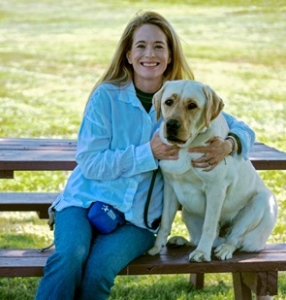 Labrador Retriever and service dog named Rock.
“I exhale now and feel happy,” she says, almost surprised by how natural that feeling has become. When she reflects on her journey with Warrior Canine Connection (WCC), she puts it even more simply: “I like to say WCC gave me a new leash on life.”
Allie first learned about WCC a couple of years ago through a Veterans Service Center in Silver Spring, Maryland, during what she describes as one of the most difficult periods of her life.
Still, something about that visit stayed with her.
“Mar (assistant director of WCC’s MBTR programs) brought Toyomi out to me, and we took a walk down the long driveway to the WCC sign. Something shifted in me in that moment—I didn’t want it to end,” she recalls. “I still have the photo from that day, and when things get hard, I go back to it to ground myself. I knew then my life would never be the same.”
That moment became a turning point. She returned to WCC again—and again—slowly finding herself more engaged each time.
At first, Allie thought she was simply there to heal herself. But through Mission Based Trauma Recovery (MBTR)—WCC’s hands-on, purpose-driven approach that pairs Warriors with service dog training activities designed to help both the Veteran and the dog recover, learn and grow—her perspective began to expand.
She participated in MBTR training sessions, puppy yoga at Platoon 22 and volunteered at the Healing Quarters, all while gradually taking on more hands-on work with WCC service dogs in training.
“I started all of this thinking it was just to help myself,” she says. “But then I realized I’m helping someone else who has been in my position—what we’re doing here can potentially save a life and help reconnect a family.”
As Allie’s involvement grew, so did her confidence. She moved from early socialization work into independent handling, eventually even stepping into moments that pushed her far outside her comfort zone.
One of those moments was speaking publicly for the first time since being in the military—at a WCC Puppy Raiser education event, where Allie shared her MBTR experience.
“I was terrified,” she says. “But everyone has been so kind to me along the way. I haven’t experienced that since I got out of the military.”
A former Air Force Security Forces member, Combat Arms Training and Maintenance Instructor and Military Training Instructor with nearly 15 years of service, Allie was medically retired after an epilepsy diagnosis. Her transition to civilian life was marked by instability, recovery and many ups and downs.
“I would like to credit my mother, my family and friends and WCC as major anchors in that progress,” shared Allie. “I’m not embarrassed anymore to say how this has saved my life. It stopped me from committing suicide, it’s stopped me from making poor decisions, helped my get healthy and want to help other Veterans to do the same for themselves and their families and friends.”
Today, Rock is her partner in every sense of the word. The two are preparing to graduate together as part of WCC’s Class of 2026, and their bond continues to deepen through daily work and routine.
“Rock has shown me it is okay to ask for help and to accept myself for who I am on the good days and on the bad,” said Allie. “I am looking forward to so many more wonderful days with him right by my side. I love him so much and I tell him every day.”
Rock—an affectionate, playful pup born on April Fool’s Day—has become a grounding presence for Allie, especially during moments of stress or PTSD triggers like loud or sudden noises, lights and memories.
“He just knows,” she says. “He taps my foot, comes close, he looks me in the eye, snuggles and it calms me down.”
Rock was named in honor of Sergeant William “Bill” Green, Sr., a Marine Corps and Vietnam Veteran, retired police officer and Maryland native whose legacy of service aligns closely with Allie’s own background in security forces and military service. Allie says she hopes to meet him in person one day soon.
Looking back on her experience, she is quick to highlight not just the dogs, but the people who helped her get here.
“It’s not even just about the dogs,” Allie says. “The people there are so kind. You’re part of the family—even before you’re matched with a dog. It’s comparable to the camaraderie I felt in the military.”
Her advice to other Veterans is simple: stay open, have faith, there is always hope.
“Just remember that WCC is a no-fail mission and if you believe in yourself and those around you, good things will follow,” she shared.
For Allie, that openness didn’t just lead to a program—it led to stability, connection and a steady partner walking beside her on a very different path forward.
###








Warrior Spotlight: Finding Independence, Purpose and Connection
Severe spinal injuries eventually left him permanently disabled, resulting in chronic pain, mobility limitations and the day-to-day challenges of navigating life using a wheelchair for mobility. Through it all, both Wounded Warrior Project and Warrior Canine Connection became vital sources of support for Ken and his family.
“WWP has been great for us,” Ken said. “They’ve helped me, they’ve helped my wife. They’ve connected us with VA resources, supported us through navigating home modifications to make our living space more accessible, and there have been programs for the kids. Early on, I couldn’t do much, but the support they’ve given my wife as a caregiver has been huge.”
Ken’s wife, Cristine, left her career as a firefighter with Montgomery County, Maryland, to help care for him full-time. Through WWP’s Independence Program and caregiver support services, she received the support she needed, and the family found resources to help navigate VA benefits, home modifications and the transition into a new way of life.
Beyond his family and recovery journey, Ken has also found grounding in a long-standing personal passion: genealogy. He spends time tracing family history and helping piece together ancestral lines, including connections reaching back to the American Revolution. For him, it’s a meaningful way to stay engaged in storytelling, history and the idea that every life is part of something larger.
Years later, another breakthrough came unexpectedly through dogs.
Although Ken had always loved dogs, his connection to WCC deepened after one of his children began volunteering there. He attended orientation alongside his son and learned about WCC’s Mission Based Trauma Recovery (MBTR) program, which enlists Veterans in recovery to help train service dogs for their fellow Warriors.
“And it was fantastic,” Ken said. “The interactions with the dogs at WCC also helped with my pain management, to the point where I could start doing a little bit more.”
That connection extended beyond WCC’s campus. Ken said the program has strengthened his bond with his Newfoundland, Gucci, at home while also helping him continue building his dog-handling and training skills.
That “little bit more” became something much bigger.
“Now I’m able to spend more time with my family, with the dogs and I can do a few other things throughout the week,” he said. “To go from, ‘I can’t do anything by myself’—virtually no independence—to there’s so much stuff I want to do. I can do more than I’ve been able to do in 15 years. It’s been a saga.”
Today, Ken participates in independent handling sessions at WCC, spending one-on-one time with service dogs in training through enrichment, grooming, play and affection. He’s also on the waitlist for a service dog of his own.
“The more time I spend with the dogs, the better,” he said. “The Labs give so much of themselves to you. You can feel the difference after spending time with them.”
For Ken, the journey continues—one built on family, perseverance and the healing power of connection.
###
The Healing Power of the Human-Canine Connection
At Warrior Canine Connection (WCC), connection is at the heart of the organization’s Mission Based Trauma Recovery (MBTR) program. Through MBTR, Veterans help train future service dogs for their fellow Warriors while building meaningful relationships along the way—with the dogs, fellow Veterans and often themselves.
Participants frequently describe the impact in deeply personal ways.
“The overlaps in ways working with the dogs has with ways of solving problems and communication in other parts of my life is quite profound.”
– MBTR participant
Others share how the experience extends beyond the training environment and into daily life.
“WCC has been a great experience and I’m using the things I learned to train the dog I have at home. It has been a wonderful experience and I hope to contribute more in the future.”
– MBTR participant
Research continues to show that human-canine interaction can help reduce stress, lower anxiety and improve emotional regulation. For some Veterans, the impact can be life-changing.
One MBTR participant shared that after years of treatments, therapies and medications, working with a WCC dog helped quiet their hypervigilance for the first time in years.
“After all the treatments, medications and therapies I have trialed over six years, none touched my hypervigilance. The experience I had with taking Oxler to the grocery store was the first time in eight years I wasn’t watching exits or looking at people and analyzing them as threats to me. I was focused on him and his needs to meet training requirements. I honestly cried on the drive home after because it was such a relief to just not have those thoughts in a place as simple as a grocery store. I wasn’t worried about anything else—just him. It’s life changing to know I could feel that level of relief in the future when I get placed with my own dog.”
– MBTR participant
That healing happens on multiple levels—through the bond between Veteran and dog, connection with fellow Veterans and renewed purpose in helping prepare a future service dog for another Veteran in need.
During PTSD Awareness Month and throughout the year, WCC continues to highlight the power of connection, purpose and the human-canine bond in supporting recovery and resilience.
###
Sit. Stay. Read.
Not surprisingly, many of the recommendations highlight the powerful bond between humans and dogs, especially service dogs and military working dogs. Several titles earned multiple mentions, including “A Dog Called Hope,” “Thunder Dog” and “Craig & Fred.” Others revisited timeless classics like “The Incredible Journey,” “Old Yeller,” “Where the Red Fern Grows” and “Because of Winn-Dixie,” stories that clearly continue to resonate across generations.
From touching memoirs to childhood favorites, your recommendations reminded us just how meaningful dog stories can be. We received an overwhelming response to our post and did our best to include as many recommendations and contributors as possible below. If we inadvertently missed a few, please know how much we appreciate everyone who took the time to share their favorite reads with us.
From all of us at WCC, happy summer reading!
– Sue Norwood
– Marjorie Brooks Lipson
– Florence Scarinci
“Watchers” and “Devoted” by Dean Koontz
– Becca Twaits
– Megan Powell
– Celeste Diehm
– Joyce A. Levair
– Dianne Cochran
– Debbie DiMaggio Sarno
– Karen Zipf Filkins
– Tracy Ballard
– Susan Kent Avajan
– Dr. Jessica Rabin
###
WCC’s Jill: Following Her Nose, Safeguarding Communities
At the center of that effort is Jill, a Labrador retriever from Warrior Canine Connection (WCC), and the first dog placed in NCIS’s Electronic Storage Detection (ESD) K-9 program. She lives and works full time with NCIS Program Manager, Special Agent David Lawhorn, accompanying him into the office each day and serving in a role that bridges Veteran service, canine training and federal law enforcement.
The program is part of a growing effort within NCIS to enhance investigations involving hidden digital evidence. The dogs are trained to detect odor signatures associated with electronic storage devices—tools that can be concealed in everyday objects and used in criminal activity involving military families and national security concerns.
But Jill’s story begins far from the kennel and the lab.
David’s path to creating the program started with a long career of service. A former mechanic in the U.S. Air Force, he spent eight years on active duty before joining NCIS in 2005, where he worked civilian law enforcement cases tied to the U.S. Navy and Marine Corps. A conversation about his younger self ultimately resurfaced a long-dormant ambition.
“If you could talk to your 15-year-old self, what would you tell yourself to do?” he recalled being asked. His answer was immediate: “I always wanted to fly Apache helicopters and work with dogs.”
While one dream had passed, the other became a possibility. That moment set in motion years of research, proposal writing and program development that ultimately led to the launch of the NCIS Electronic Storage Detection K-9 program in 2024. Jill was its first graduate.
Today, she is more than a working dog—she is a daily presence in the office and a steady companion in the field. According to David, her impact extends well beyond operational value.
“If we’re not there, people ask where Jill is,” he said. “Nobody cares if I show up. I’m just the other end of the leash.”
Still, he is quick to emphasize what the dogs enable investigators to do.
“These devices are getting smaller and easier to hide,” David said. “They can be placed inside ordinary objects meant to avoid detection. The dogs help us find what people would otherwise miss.”
Electronic detection dogs, like Jill, are trained to locate hidden storage devices such as memory cards, thumb drives, cell phones and hard drives—items that can be concealed inside ordinary objects like key fobs, wine corks or toy containers. These devices may contain critical digital evidence related to serious crimes, including child exploitation and other criminal activity. By alerting investigators to the presence of electronics, dogs help uncover items that might otherwise go unnoticed during searches.
Jill’s journey began at WCC, where dogs are raised and trained alongside Veterans participating in Mission-Based Trauma Recovery (MBTR). Through the program, Veterans help train the dogs for their fellow Warriors, while supporting their own healing. Some dogs go on to become service dogs for Veterans, while others—guided by their strengths and instincts—choose different paths, including detection work, search and rescue, facility support roles or even life as a beloved pet in a military family.
When WCC dogs reach approximately 18 months of age, they enter the final stage of training, where professional trainers assess command comprehension, confidence in public settings and overall drive to work. While most dogs move into service, facility or military family support roles, some are better suited for alternative paths based on factors such as energy level or motivation. Dogs that may not be suited for traditional service roles, including those with lack of house manners or prey drive, often thrive in detection environments. Training relies entirely on positive reinforcement, with handlers using rewards to shape detection behavior.
“Especially for our high-energy dogs, having the opportunity to use their nose and stay physically busy helps channel their energy productively,” said Jennifer Blessing, a WCC service dog training instructor. “Many of the behaviors that aren’t ideal for assistance work are perfectly suited for detection roles, making it a win-win for dogs that need extra mental stimulation and a clear task to complete.”
For David, Jill is more than a partner on the job—she is the living result of a career shift that turned a personal dream into a capability now serving NCIS every day.
Today, Jill’s work, along with several others who came through WCC, is a powerful reminder that a dog trained to support Veterans can also help protect their families and the communities they call home.
###
Finding Peace and a “New Leash on Life”
For Air Force Veteran Allison “Allie” Butts, PTSD Awareness Month isn’t an abstract observance—it’s something she lives every day, and something she now navigates with the steady presence of a 72-pound yellow Labrador Retriever and service dog named Rock.
“I exhale now and feel happy,” she says, almost surprised by how natural that feeling has become. When she reflects on her journey with Warrior Canine Connection (WCC), she puts it even more simply: “I like to say WCC gave me a new leash on life.”
Allie first learned about WCC a couple of years ago through a Veterans Service Center in Silver Spring, Maryland, during what she describes as one of the most difficult periods of her life.
Still, something about that visit stayed with her.
“Mar (assistant director of WCC’s MBTR programs) brought Toyomi out to me, and we took a walk down the long driveway to the WCC sign. Something shifted in me in that moment—I didn’t want it to end,” she recalls. “I still have the photo from that day, and when things get hard, I go back to it to ground myself. I knew then my life would never be the same.”
That moment became a turning point. She returned to WCC again—and again—slowly finding herself more engaged each time.
At first, Allie thought she was simply there to heal herself. But through Mission Based Trauma Recovery (MBTR)—WCC’s hands-on, purpose-driven approach that pairs Warriors with service dog training activities designed to help both the Veteran and the dog recover, learn and grow—her perspective began to expand.
She participated in MBTR training sessions, puppy yoga at Platoon 22 and volunteered at the Healing Quarters, all while gradually taking on more hands-on work with WCC service dogs in training.
“I started all of this thinking it was just to help myself,” she says. “But then I realized I’m helping someone else who has been in my position—what we’re doing here can potentially save a life and help reconnect a family.”
As Allie’s involvement grew, so did her confidence. She moved from early socialization work into independent handling, eventually even stepping into moments that pushed her far outside her comfort zone.
One of those moments was speaking publicly for the first time since being in the military—at a WCC Puppy Raiser education event, where Allie shared her MBTR experience.
“I was terrified,” she says. “But everyone has been so kind to me along the way. I haven’t experienced that since I got out of the military.”
A former Air Force Security Forces member, Combat Arms Training and Maintenance Instructor and Military Training Instructor with nearly 15 years of service, Allie was medically retired after an epilepsy diagnosis. Her transition to civilian life was marked by instability, recovery and many ups and downs.
“I would like to credit my mother, my family and friends and WCC as major anchors in that progress,” shared Allie. “I’m not embarrassed anymore to say how this has saved my life. It stopped me from committing suicide, it’s stopped me from making poor decisions, helped my get healthy and want to help other Veterans to do the same for themselves and their families and friends.”
Today, Rock is her partner in every sense of the word. The two are preparing to graduate together as part of WCC’s Class of 2026, and their bond continues to deepen through daily work and routine.
“Rock has shown me it is okay to ask for help and to accept myself for who I am on the good days and on the bad,” said Allie. “I am looking forward to so many more wonderful days with him right by my side. I love him so much and I tell him every day.”
Rock—an affectionate, playful pup born on April Fool’s Day—has become a grounding presence for Allie, especially during moments of stress or PTSD triggers like loud or sudden noises, lights and memories.
“He just knows,” she says. “He taps my foot, comes close, he looks me in the eye, snuggles and it calms me down.”
Rock was named in honor of Sergeant William “Bill” Green, Sr., a Marine Corps and Vietnam Veteran, retired police officer and Maryland native whose legacy of service aligns closely with Allie’s own background in security forces and military service. Allie says she hopes to meet him in person one day soon.
Looking back on her experience, she is quick to highlight not just the dogs, but the people who helped her get here.
“It’s not even just about the dogs,” Allie says. “The people there are so kind. You’re part of the family—even before you’re matched with a dog. It’s comparable to the camaraderie I felt in the military.”
Her advice to other Veterans is simple: stay open, have faith, there is always hope.
“Just remember that WCC is a no-fail mission and if you believe in yourself and those around you, good things will follow,” she shared.
For Allie, that openness didn’t just lead to a program—it led to stability, connection and a steady partner walking beside her on a very different path forward.
###
Want a Second Dog? Trainers Say These 7 Breeds Fit Into Any Home So Easily
There’s no denying that choosing a second dog breed can be tricky as narrowing down the best dogs for multi-dog households isn’t as simple as it may seem. Because of that, bringing a new dog into a home with other pets can be an exciting, but sometimes a challenging experience as well. Read the full story in the Charlotte Observer here.
How Expensive Are Service Dogs, Really?
Service dogs are highly trained animals that assist individuals with specific disabilities, like blindness, hearing loss, mental health issues, and an assortment of other medical conditions. You’ve likely seen one of these hardworking, vested pups in action before. Read the full story in A-Z Animals here.
2025 ACE Award Service Dog Category Winner: Bea
Bea, a Labrador Retriever, is the AKC Humane Fund Award for Canine Excellence winner in the Service Dog category. She is the devoted companion of Buddy Niner, a Marine Corps and Air National Guard veteran, providing vital emotional support as he navigates life after service. Bea’s impact extends beyond buddy, offering comfort and support to his fellow firefighters as well. Watch the story on AKC TV here.
By the Numbers: Volunteer Impact in 2025
In 2025 alone, 838 dedicated volunteers gave 137,507 hours of their time, generating an extraordinary $4.7 million in impact. Every one of those hours helped train service dogs and support the healing journeys of Veterans and Military Families.
That impact includes 101 Veteran volunteers and 213 Military Family volunteers whose lived experiences strengthen the very community we serve, along with corporate partners who contributed 787 hours of hands-on support. During Volunteer Appreciation Month, we celebrate more than numbers — we celebrate the hands, hearts and commitment that move this mission forward every single day.
“We celebrate every role and every hand that gives to WCC — those who care for the dogs in the kennels, those who nurture our moms and babies, the volunteers who prepare meals for our veterans when they are matched, our devoted sitters and our dedicated puppy raisers,” said Molly Elmore, WCC volunteer program manager. “Each act of service, whether quiet or visible, carries a heartfelt impact. I am profoundly grateful that our diverse group of volunteers are united by a shared commitment to something bigger than themselves.”
If you’ve ever considered getting involved, there’s a place for you here. Whether you can give a few hours or make a deeper commitment, your time can help change lives. We invite you to learn more about joining our volunteer community and becoming part of this mission in action. Learn more about how you can get involved here.
###
Bridget & WCC’s Mary Gene: A Life-Changing Bond
Bridget shares what this partnership has meant to her and the impact it’s had on her daily life, offering a glimpse into the profound difference a service dog can make.
Mary Gene’s name carries its own legacy of service. She was named in honor of United States Army Major Mary Gene Klein Martin, a dedicated nurse, leader and longtime WCC volunteer whose commitment to serving others, both in and out of uniform, continues to inspire.
More information about Mary Gene’s namesake, and all of the Veterans whose names have been bestowed on WCC puppies can be found on the organization’s Hall of Heroes.
Watch Bridget’s story and see how one extraordinary connection is changing a life.
###