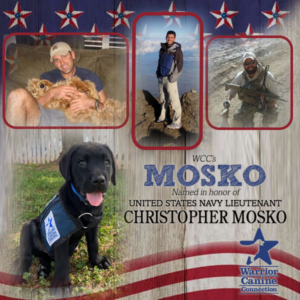
 Gold Star Dad John Mosko has an online blog now used to memorialize his son, Navy Lieutenant Christopher “Chris” Mosko, who was killed in Afghanistan. The process was therapeutic, albeit very emotional for him. The practice allowed him to openly share his thoughts, feelings, and grief, but perhaps even more purposeful, was a way to keep Chris’ memory alive.
Chris was an explosive ordinance disposal (EOD) technician. He was killed on a road in Afghanistan by an improvised explosive device (IED) on April 26, 2012. John says not a day goes by that he, his wife, Gayle, and daughter, Meredith, don’t think about Chris.
So, when John and Gayle were approached by the University of Pennsylvania NROTC unit about having a Warrior Canine Connection (WCC) service dog in training named after Chris, it was an automatic yes.
John shared a story about their family’s first pet — a black Lab named Topper. The kids, Chris and his younger sister, Meredith, were young — in the single digits at the time. John says Topper and Chris were fast friends, pretty much inseparable — they grew up together. So, when John learned WCC’s Mosko, named for Chris, was a black Lab, it just felt right.
“We are excited that Mosko’s been named after Chris, it’s one more way to keep his memory alive and share stories about him,” said John. “And to know this dog will go on to help other Veterans, it’s very much in line with how Chris lived his life — reaching out to others, helping them, and being appreciative of what he had and of others.”
Military service was a calling for Chris. John recalls an early moment he traces back to his first inclination Chris would go on to serve his country.
“When he was about 5 years old, we were watching the Army vs. Navy game, and Chris said, ‘one day I want to be one of them and he pointed to the Midshipmen,’” shared John. “And sure enough, years later, he ended up going into the ROTC program.”
Chris attended Drexel University, where he studied commerce and engineering. A soccer player in high school, Chris tried out for Drexel’s soccer team while simultaneously attending ROTC orientation. Afterward, he was offered a redshirt position on the soccer team, much to his and his family’s surprise, and a spot on the ROTC squad. John said his choice was immediately clear.
“Chris said ‘that ROTC orientation week was the best week of my life,’” said John. “It wasn’t an easy week, either. They put those kids through the ringer to make sure they knew what they’re getting themselves into and that they would honor their commitment.” John added, “He loved it, loved his teammates, and just loved the whole ROTC community.”
Although Chris attended Drexel, he participated in the ROTC program through the University of Pennsylvania — which still serves as the host ROTC program for all Philadelphia area colleges and universities. It’s where Chris met his wife, Amanda, who was also in the ROTC program.
The ROTC program at Penn is also a new training site for WCC’s Mission Based Trauma Recovery (MBTR) service dog training program, where WCC’s Mosko trains with area Veteran students and faculty. WCC’s MBTR program teaches Veterans to train service dogs for their fellow Warriors. The program fulfills a time-honored military tradition of Warriors helping Warriors, and in doing so, Veterans can also benefit from their own skills development in communication, confidence building, accountability, emotional regulation and patience.
John says Chris’s affinity to serve likely started with his own father, Milton Mosko, who served in the U.S. Army and fought in Korea.
“When Chris hit ROTC, he and my dad talked about stuff my dad never talked to me about, so there was a bond between them,” said John. “What Chris was doing really opened up my dad to talk about it a little bit more. One really special moment for us all was when Chris was commissioned at the Union League in Philadelphia and my dad was there to put his bars on.”
John says losing his son has been the one great tragedy in his family’s lives.
“We still try to laugh and do find joy in things, but there are no guarantees in life or for tomorrow,” said John. “So, we try to do things to keep his name alive, honor him, and introduce him through stories to those who never had the chance to meet him.”
Chris lives on in dinner table conversations, family gatherings, holidays, anniversaries, through Veterans’ events the Moskos attend, and now, through a little black Lab named in his honor.








Pups With A Purpose: This group is helping veterans through the companionship of furry friends
War takes a physical, emotional, and mental toll on someone that only combat veterans understand. In fact, when many veterans return home, they have trouble adjusting to the life they used to know. That is where Warrior Canine Connection comes in. Watch the full story on RFD TV here.
The Blue Angels Foundation Gifts $50,000 to Warrior Canine Connection
“I know I speak for our entire team at the Blue Angels Foundation when I say we are proud to support Warrior Canine Connection because it provides life-changing programming for Veterans and their families,” said Dr. Mykityshyn. “We know service dogs are a crucial tool to combating PTSD, and the unique Mission Based Trauma Recovery training that Warrior Canine Connection provides offers a real therapeutic benefit and is a valuable resource to helping Veterans in their recovery.”
The Blue Angels Foundation is the charitable arm of the Blue Angels Association and is led by former members of the U.S. Navy Flight Demonstration Squadron. The BAF’s mission is to have a positive impact on resolving post-traumatic stress among wounded Veterans by saving lives and promoting positive transitions for wounded Veterans and their families. With research and evidence pointing to the positive impact service dogs have on Service Members and Veterans, the BAF chose to support WCC.
Each year, the BAF aims to expand its footprint and impact in critical areas facing wounded Veterans and their families. Key areas of support include transitional housing, counseling, PTSD resolution, life skills, and providing employment opportunities for transitioning wounded Veterans.
New Faces at WCC: Leilani Shore and Riley Spickler
Please join us in welcoming two new members to the WCC pack! Both Leilani Shore, puppy program outreach coordinator, and Riley Spickler, puppy development assistant, joined WCC in December helping to fulfill important roles — learn more about out new team members!
An animal lover at heart, Leilani has always gravitated to dogs and horses. While attending Ohio University, she also worked for an equine program that supported Veterans through therapeutic horsemanship.
After graduating with a dual bachelor’s in psychology and animal science, she went on to work for an equine program that provided support for kids in foster care. She then worked for an animal biotech company that provided at-home cat DNA tests; the results are used to give owners a comprehensive report on their cats.
When she saw the opening at WCC for a Puppy Program Outreach Coordinator, it was one she knew she couldn’t pass up.
“I love my job,” said Leilani. “It’s not very often people can say that.”
Although still new to the role, Leilani works directly with WCC’s Puppy Parent program to help recruit new volunteers and support those already providing crucial aid and care for its service dogs in training.
“The Puppy Parents are awesome … it’s amazing that people are willing to volunteer their time and do what it takes to raise these dogs for us; we couldn’t do what we do without our Puppy Parents,” said Leilani. “I’m always in awe of them with how they sacrifice their time for us and help us out.”
When not working, Leilani enjoys spending time with her two dogs, Luna and Rosco, and her two horses, Ramsey and Maverick.
Also joining WCC in December is Riley Spickler, our new Puppy Development Assistant. In her role, Riley works in WCC’s puppy department and helps with the socialization and care of WCC’s older pups and eventually be taking on the position of boots rank instructor.
A Maryland native, Riley graduated from the University of Maryland, College Park, with a bachelor’s in animal and avian sciences. During her sophomore year, she helped co-raise and sit service dogs for the Guide Dog Foundation and has spent countless hours walking and pet sitting dogs since then. She was also very involved in her campus ministry during college and loves connecting with new people.
“I have had a long-time dream of working with Veterans and service dogs, so this job is a perfect combination of both,” said Riley.
Riley’s supervisor says she has made an immediate impact in her new role.
Outside of work, Riley can often be found attending University of Maryland basketball games, spending time with friends and she also hosts trivia at a local brewery.
WCC’s Manion: From Service Dog in Training to Search & Rescue
To graduate from WCC’s service dog training, a dog must pass all of the necessary health tests as well as their training courses. As our excellent trainers get to know the dogs better through training and socializing, they are able to understand what a dog is good at and what they need to improve on. Our trainers have special bonds with each and every dog that comes through the program, and helping the dogs determine their future is an essential objective.
WCC’s Manion, named in honor of U.S. Marine Corps First Lieutenant Travis Manion, is a great example of a successful career change. One of the first traits that began to emerge with Manion was his work drive.
“Manion’s motivation to serve others is his most unique trait,” said Manion’s first puppy parent, Patrick Siemon, who spent seven months helping raise Manion. “He has always been so focused on whoever has the other end of his leash and is always ready to work. He looks at whoever he is training with like they are the only person on earth and rarely takes his eyes off of them.”
When Manion was around 9 months old, his service dog training began. WCC trainer Jen Blessing had the honor of being Manion’s main handler and trainer while he was at WCC.
“When Manion first got here, he was a crazy puppy with no boundaries,” said Jen. It didn’t take long for Jen’s training to start making a difference, though. “It was a little rough for the first couple of weeks, but then Manion really snapped into it. He just needed a little help.”
Before long, Manion was paws deep in training, even accompanying Jen to Walter Reed National Military Medical Center “almost every day.”
As the training progressed, Jen noticed that while Manion was enthusiastic in trying to learn, his house manners stilled needed some work. He was having a tough time breaking his habit of counter surfing for food.
“He’s so smart that he learned how to get away with things, and his drive for food beat everything else. He had an over-arousal with food,” said Jen. “Bad house manners are one of the pretty clear indicators that a dog may not be a good fit as a service dog,” she explained.
Two things had become clear to Jen: Manion had a high work drive, and Manion was food driven. After a stall in Manion’s progress in the training, WCC decided an environmental reset could help fully unlock Manion’s potential, so he was brought to WCC’s Asheville, North Carolina, location. There, he continued to show a strong desire to work, but his endless stamina and devotion to food were still holding him back from his service dog training.
After about six months in Asheville, Manion returned to WCC’s Healing Quarters in Boyds for an evaluation. The trainers at WCC collectively decided that Manion’s high energy and house manners may not be ideal for a service dog.
The next step was to figure out what career would be a good fit for Manion, and Jen shared her input with the other WCC trainers: “He needs to have a job. He loves to work and is way too smart. Manion needed to be placed with an active person who will keep him stimulated. He clearly loves to work.”
Among the possibilities WCC trainers discussed was the career of being a search and rescue dog. “Work drive and toy drive has to be so high for a search and rescue dog,” continued Jen, and Manion had both of those traits. “We reached out to the National Disaster Search Dog Foundation (SDF), and they asked for videos of Manion doing certain things, like trying to find a ball in a field, so we laid a foundation with his toy drive. They ended up liking him.”
Manion made his career change and joined SDF, where he has fit right in. His work drive, toy drive and motivation for food made him the perfect fit for SDF. He has already assisted in multiple search and rescue missions, including one in Florida after Hurricane Ian devasted the state.
Jen and the rest of WCC continues to follow Manion’s journey with pride, joy and love. Even Manion’s first puppy parent, Patrick, still closely follows Manion’s growth with SDF. “When WCC told me they thought being a search dog would be a better fit for him due to his high energy, it made sense. I can’t wait to see what Manion and the Search Dog Foundation will get to do next to help others!”
You can follow Manion’s journey by following The National Disaster Search Dog Foundation on social media and Manion’s own Instagram page.
Paw-some Holiday Gift Ideas to Spoil Your Furry Friend
Toys, Toys and more Toys
WCC Service Dog Training Instructor Michele Tate, who works with WCC’s Asheville programs, loves the Starmark chew toys for several reasons.
“I really like this toy for pet parents because it has inserts you can buy that are super tasty, and it also works great with applesauce, peanut butter, yogurt, kibble or other treats as a fun frozen toy that can help enrich your dog both mentally and physically.”
WCC Program Director and Service Dog Training Instructor at the Palo Alto VA Alexis Baker, shared a few toys that are personal favorites of WCC’s Piccone, a service dog in training she previously worked with in Calif.
“Piccone loved to walk around and squeak this rubber chicken! It provided him with tons of entertainment, and he liked giving it to me to squeak and give back to him, and even squeaking it together!
Another favorite for many is Hugglehounds® pet toys. The organization is also a supporter of WCC, and featured two of WCC’s service dogs — Luke and Tommy II — in adorable, plush miniatures, which are for sale here.
WCC trainers recommend never leaving toys with unsupervised pets.
Special note: If purchasing gifts on Amazon, be sure to elect Warrior Canine Connection as your charity of choice on Amazon Smiles! The AmazonSmile Foundation will donate 0.5% of the purchase price your eligible purchases to WCC. To-date, AmazonSmiles has helped raise more than $29,000 for WCC.
Tasty Treats
Trainer Michele Tate also recommends these Churro Cheese Dog Treats based on her experience with her own dogs.
“I love these because I have a dog who loves to chew and a dog who hates to chew, and they both enjoy these. They help clean up the farther back molars as well and they aren’t stinky and don’t leave any yucky residue or stains as they consume them.”
Safety device
Another great idea includes a practical gift that is useful and will help keep your dog safe.
Alexis Baker shared one of her favorite safety items — a rechargeable light- up collar, which she says, “is great to help your dog be more visible at night!”
Gifts for Humans, too
Don’t forget to treat the humans in your life or perhaps yourself, too, with WCC’s annual holiday ornament. The 2022 edition features two options — a black or yellow Lab — with the WCC logo and they are available for purchase on the WCC website.
Another favorite is the WCC calendar, and 2023 is now available! Complete with adorable photos of WCC dogs; a new image will bring a smile to your face each month. Check out the 2023 WCC calendars here.
Happy holidays and happy shopping ahead!
WCC’s Mosko — Service Dog in Training and Living Legacy
Chris was an explosive ordinance disposal (EOD) technician. He was killed on a road in Afghanistan by an improvised explosive device (IED) on April 26, 2012. John says not a day goes by that he, his wife, Gayle, and daughter, Meredith, don’t think about Chris.
So, when John and Gayle were approached by the University of Pennsylvania NROTC unit about having a Warrior Canine Connection (WCC) service dog in training named after Chris, it was an automatic yes.
John shared a story about their family’s first pet — a black Lab named Topper. The kids, Chris and his younger sister, Meredith, were young — in the single digits at the time. John says Topper and Chris were fast friends, pretty much inseparable — they grew up together. So, when John learned WCC’s Mosko, named for Chris, was a black Lab, it just felt right.
“We are excited that Mosko’s been named after Chris, it’s one more way to keep his memory alive and share stories about him,” said John. “And to know this dog will go on to help other Veterans, it’s very much in line with how Chris lived his life — reaching out to others, helping them, and being appreciative of what he had and of others.”
Military service was a calling for Chris. John recalls an early moment he traces back to his first inclination Chris would go on to serve his country.
“When he was about 5 years old, we were watching the Army vs. Navy game, and Chris said, ‘one day I want to be one of them and he pointed to the Midshipmen,’” shared John. “And sure enough, years later, he ended up going into the ROTC program.”
Chris attended Drexel University, where he studied commerce and engineering. A soccer player in high school, Chris tried out for Drexel’s soccer team while simultaneously attending ROTC orientation. Afterward, he was offered a redshirt position on the soccer team, much to his and his family’s surprise, and a spot on the ROTC squad. John said his choice was immediately clear.
“Chris said ‘that ROTC orientation week was the best week of my life,’” said John. “It wasn’t an easy week, either. They put those kids through the ringer to make sure they knew what they’re getting themselves into and that they would honor their commitment.” John added, “He loved it, loved his teammates, and just loved the whole ROTC community.”
Although Chris attended Drexel, he participated in the ROTC program through the University of Pennsylvania — which still serves as the host ROTC program for all Philadelphia area colleges and universities. It’s where Chris met his wife, Amanda, who was also in the ROTC program.
The ROTC program at Penn is also a new training site for WCC’s Mission Based Trauma Recovery (MBTR) service dog training program, where WCC’s Mosko trains with area Veteran students and faculty. WCC’s MBTR program teaches Veterans to train service dogs for their fellow Warriors. The program fulfills a time-honored military tradition of Warriors helping Warriors, and in doing so, Veterans can also benefit from their own skills development in communication, confidence building, accountability, emotional regulation and patience.
John says Chris’s affinity to serve likely started with his own father, Milton Mosko, who served in the U.S. Army and fought in Korea.
“When Chris hit ROTC, he and my dad talked about stuff my dad never talked to me about, so there was a bond between them,” said John. “What Chris was doing really opened up my dad to talk about it a little bit more. One really special moment for us all was when Chris was commissioned at the Union League in Philadelphia and my dad was there to put his bars on.”
John says losing his son has been the one great tragedy in his family’s lives.
“We still try to laugh and do find joy in things, but there are no guarantees in life or for tomorrow,” said John. “So, we try to do things to keep his name alive, honor him, and introduce him through stories to those who never had the chance to meet him.”
Chris lives on in dinner table conversations, family gatherings, holidays, anniversaries, through Veterans’ events the Moskos attend, and now, through a little black Lab named in his honor.
WCC Programs Expand Reach
Warrior Canine Connection’s programs continue to see growth, both locally in nearby Frederick, Maryland, as well as at two new sites — one in Pennsylvania and another in Virginia.
November marked the official start of WCC’s new program at the University of Pennsylvania in collaboration with its Perelman School of Medicine and Veterans Care Excellence Program (VCEP). The program provides WCC’s Mission Based Trauma Recovery (MBTR) training program on campus for area Veteran students, staff and community members, and has five service dogs in training on site.
Funding for the WCC program at Penn was provided by Team Foster, a local Philadelphia-based Veteran support organization dedicated to serving disabled Veterans through community support, Veteran peers and highly trained service dogs.
Also in November, roughly 20 miles from WCC’s Healing Quarters in Boyds, Platoon 22, a non-profit organization who mission is to end Veteran suicide opened the doors to its new Platoon Veteran Services Center at Goodwill in Frederick, Md. The space provides much-needed resources and support for Veterans transitioning from service to civilian life. WCC is offering its Mission Based Trauma Recovery (MBTR) programming on-site several days a week as one of its ongoing support programs.
In Virginia, WCC has begun working with the Rappahannock Regional Veterans Treatment Docket which is being held at the Spotsylvania Circuit Court in Northern Virginia. In support of this Veterans Treatment Court (VTC) programming, WCC is engaging Veterans in MBTR classes to satisfy community service hours—often a requirement for graduation from the court. The dog training — offered through WCC — is one of the options on the docket. Training takes place on a weekly basis at the courthouse and Veterans can participate within the WCC program for the duration of their VTC commitment. The program is in addition to WCC VTC programming taking place at locations in California, Maryland and North Carolina.
Warrior Spotlight: Air Force Veteran Amber Adams Finds Solace in Training Service Dogs
After being honorably discharged from the U.S. Air Force, Adams sought out WWP as a way to connect with other Veterans and to find resources to help with her mental and physical health. She’s participated in fishing, kayaking, beekeeping, and a myriad of other activities, but when it came to WCC’s program and working with its puppies and dogs, she was hooked.
“When I learned about the mission, I got really excited about volunteering there,” said Adams. “I like the companionship of the dogs; I bonded really quickly with WCC’s Dana and WCC’s Ember, and I like knowing that the training and enrichment of the puppies will benefit future Veterans.”
Adams started volunteering her time at WCC to help with the whelping and socialization of WCC puppies a few times a month. Then, she learned about its Mission Based Trauma Recovery (MBTR) program and participated in the 8-week program learning how to train future service dogs for fellow Warriors. The program teaches Veterans in their own recovery to train service dog for fellow Warriors. In doing so, they receive their own therapeutic benefit from skills development in communication, confidence building, accountability, emotional regulation, patience and more by promoting an act of service.
While completing the MBTR program, Adams also participated in a University of Maryland research study that was funded by National Institutes of Health (NIH), which spanned 2018 to 2022, with a pause for COVID. Veteran participants with PTSD, like Adams, wore heartrate monitors and had saliva swabs taken before and after their interaction with the dogs to measure changes in their heart rate variability, cortisol and physiological stress indicators. Researchers are studying the correlation between the presence of service dogs, quality of life, and level of reported PTSD symptoms. The study will end in January 2023 and the results will be available later in 2023.
“It’s great training for me with my anxiety and PTSD; it’s easier to connect with a dog than a human sometimes,” said Adams. “The mindfulness is great … I’ve become so aware of the tone of my voice, become more patient, and focusing on communicating effectively with the dogs.”
Adams’ father and two sisters both served in the Army and her mother was a teacher. She went to college to be a teacher as well, but after landing only long-term subbing positions, she decided the Air Force would be a great way to go — enabling her to learn a new language and serve her country at the same time.
She spent a year and a half learning the Pashto language spoken by the Taliban at the Defense Language Institute Foreign Language School after basic training. Adams served seven years in the Air Force as a cryptologic language analyst, providing force protection for members of the U.S. military in Afghanistan.
She now works for one of Federal Emergency Management Agency’s (FEMA) Urban Search & Rescue Task Force as a grants manager. When a natural disaster or terror event happens, she helps to manage the funding and finances for deployments to those areas.
Adams encourages any Veterans who are looking for new hobbies, things to do, and a connection to other like-minded people, to check out WWP.
“It’s not a one-size-fits-all approach, there’s a lot of different activities, and a variety of offerings — everyone can find something to do,” said Adams. “It will definitely open your world up to so many other opportunities!”
To learn more about WWP and its programs, click here.
Training service dogs for military members is therapy for veterans at Penn’s new program
Dogs are bred specifically for the program and are mostly Labradors and golden retrievers — breeds smart and sturdy enough to help veterans with both mental and physical disabilities.
Curious passers-by often can’t help but peek into Jennifer Desher’s office on the University of Pennsylvania’s campus: On any given afternoon, she’s playing host to a handful of rambunctious puppies as young as nine weeks old. Read the full story from The Philadelphia Inquirer.
New Faces at WCC: Jennifer Desher
Jennifer is no stranger to working with dogs. In fact, her training roots go back to 2011 when she was living in Minot, North Dakota, because her husband, Kevin, was stationed at Minot Air Force Base. While there, she started taking in stray dogs and doing basic obedience training with them, which she learned by watching YouTube videos, and then would find them deserving homes. During that 3 year-period, she trained and rehomed 60+ dogs. Hooked on working with dogs, she took an online formal dog training class.
Jennifer traces her love of dogs back to childhood. “I have always been a dog lover,” said Jennifer. “After begging my parents for what seemed like forever, I got my first dog at 13—a Samoyed, who I named Tinker, after my grandfather who was nicknamed ‘Tink.’”
In 2013, Jennifer and Kevin moved back to their hometown in Pa. Shortly afterward, Kevin deployed with the Air National Guard. While he was gone, Jennifer spent the year in Texas, attending the Starmark Animal Behavioral Center for additional training. After completing her education, she helped run dog training programs in North Carolina and then back in their hometown of Philadelphia.
So when Jennifer saw the job posting for a brand-new WCC program at the University of Pennsylvania, she immediately filled out the application.
“Finding something like this was a dream come true for me,” said Jennifer. “It hits home since it combines my passion for the military and Veterans with dog training—it was a no-brainer. And it’s in my hometown.”
Jennifer, Kevin, and their two children Penelope, 7, and Benjamin, 1, reside in Montgomery County, Pennsylvania, along with their 11-year-old Husky, Meyla. When not working, an avid runner, Jennifer can often be found logging miles around town or at the local parks with her kids and spending time with her large, extended family. She’s also an advocate for the education of beta-propeller protein-associated neurodegeneration (BPAN), a disorder her daughter, Penelope, has that damages the nervous system.