 What do developing autonomous vehicles and training service dogs have in common? More than you might think! Before we dive into this unlikely comparison, let’s provide some context.
Enter John Alsterda, Systems Engineer at Waymo LLC, Ph.D. candidate at Stanford University, U.S. Navy Reservist, and Warrior Canine Connection (WCC) volunteer. John develops autonomous driving technology in his professional capacities, and is Puppy Parent to service dog in training, Nathan.
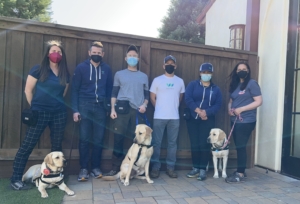
John’s work at Waymo allowed him to combine both interests, as he and fellow Veterans at the company recently gathered to host a community clean-up day – WCC’s Nathan and other WCC service dogs in training participated. The Veterans at Waymo employee resource group supports and builds community among veterans working at Waymo, including with volunteer opportunities like this one.
“There’s something about how dogs give you their undivided attention and love that is so powerful,” said John. “During my day, so many things pull on my attention and I feel like I’m always multitasking. But Nathan treats me like I’m the only other person in the world—I feel like no other animal or person has that capacity.”
John studied physics at University of Illinois for undergrad, after which he commissioned into the U.S. Navy. He spent four years at the Naval Nuclear Power School, teaching the principles of nuclear power plant operation on submarines and aircraft carriers to Navy sailors. Next, John transitioned to the Navy Reserve to pursue his Ph.D. at Stanford.
It was there he learned about Stanford’s partnership with WCC and got involved in its Mission Based Trauma Recovery (MBTR) program for Veterans. Essentially, those involved help train service dogs for their fellow Service Members and Veterans, which fulfills a time-honored military tradition of Warriors helping Warriors. In doing so, the Veteran can also benefit from social and emotional skill development, improved communication, confidence building, reduced isolation, improved emotional regulation, and reduced stress, which many of the Stanford student Veterans greatly benefit from.
From September 2019 through July 2021, John volunteered in a total of 53 MBTR sessions while working on his doctorate. Not only that, he and his wife, Ashley Fabrizio, also helped with puppy sitting needs, followed by becoming Puppy Parents to WCC’s Nathan, who recently graduated to advanced training at WCC’s Healing Quarters in Boyds, Maryland.
Onto comparing autonomously driven vehicles and service dogs: As John can tell you, the fundamentals involve training the dogs to do the things we want them to do through rewards, like attention and treats. They don’t receive rewards for behaviors we don’t want, and they quickly learn to optimize for these incentives.
“That is fundamentally similar to the way autonomous vehicles can be encouraged to do what we want them to,” said John. “We don’t need to give them treats; they’re even easier to please! By defining a mathematical reward function, we can assign points to behaviors we want or don’t want – positive rewards for good things like staying in-lane, and negative rewards (penalties) for things to avoid like lingering too long on a crosswalk. The algorithm solves this math problem over and over again to figure out how to get the most rewards and avoid the most penalties.”
This is where things get complicated … John added, “because we need to describe complex things both to our dogs and our autonomous driver, not just put your paw on the ground or stay between the lane lines. Dogs don’t understand math, but they can be taught some human language and they understand feelings like good, bad, happy, or lonely. Our cars are better at math, but it’s challenging to describe all the things they need to know with hand-tuned rewards. These less tangible things can be encoded with neural networks, which are a mathematical way to describe things like other drivers’ behavior or how to recognize street signs.”
John explains, “Nathan’s learning process may be similar to training a neural network. We can’t describe to him exactly what behaviors we want. We use commands; he kind of speaks our language that way, but we can’t use full sentences to say precisely what it means to heel or sit close to his handler. Rather, we teach Nathan complex tasks slowly and iteratively, adding one component or adjustment at a time until he learns the whole sequence. I feel like there’s a real similarity there, for things that are impossible to explicitly communicate to both Nathan and a car.”
Simply put, for service dogs and autonomous drivers, it pays to make the right decisions! We get more of the behaviors we reward with both cars and dogs. It’s pretty remarkable to realize how certain aspects of learning theory are not only similar across species, but even in the development of artificial intelligence. That said, an autonomous driver is never going to be as good at snuggling as your dog.








Suzanne & Holli Ann Take on the 2022 Warrior Games
“The overall experience was pretty amazing. It was amazing being around all the other wounded Warriors and seeing each other overcoming challenges whether they are physical or emotional,” said Suzanne. “I definitely made some new friends and even people who we were competing against, you become friends. Everyone is supporting each other. You want to win but it’s about supporting each other.”
While Suzanne participated in cycling, rowing, track, and swimming, she had a clear favorite.
“Swimming was my favorite by far. That’s my happy place. I’m very comfortable in the pool. It’s so great to be able to get back to swimming.” Suzanne credits Holli Ann for helping her feel comfortable in a pool again after her service. “It had been a number of years. Some of the struggles were just getting to a pool and being comfortable in that loud and crowded environment again. Holli Ann helped me because I had to focus on her instead of focusing on my fears. I had to focus on getting her used to the environment,” said Suzanne.
When Suzanne took Holli Ann with her to cheer on teammates in the rowing competition, it was Holli Ann who grabbed ESPN’s attention. “We were going to go cheer everyone else on. I had Holli Ann by my side and we went and stood right in the middle of the cheering section with all the people I knew in front of the rowers. Holli Ann was on ESPN because while we were cheering Holli Ann was licking everyone’s faces.”
Despite Holli Ann’s attempt to steal the spotlight, Suzanne was the star of the show, winning 10 total medals including three gold medals in swimming (50-meter freestyle, 100-meter freestyle and 50-meter backstroke) and four silver medals in track (200-meter sprint, 400-meter sprint, 800-meter race and 1500-meter race). Suzanne was also named the winner of the “Heart of the Team” Award.
Another aspect of the Warrior Games that Suzanne enjoyed was getting to know the other athletes. “I enjoyed the opportunities to hang out with the athletes in smaller groups.” It was a positive experience for Suzanne to interact with other Warriors who might have had similar or shared experiences. “It’s people that kind of get it. We are all there for our own reasons. Maybe different reasons but similar. That was probably the best experience.”
Holli Ann was able to enjoy the social scene, too, as she got to enjoy daily “puppacinos” from the coffee stand. “Holli Ann for sure ate better than I did. She got her treats and her pup cup every single day.”
The Warrior Games were an experience that Suzanne says she couldn’t have done without having Holli Ann by her side. “I don’t think I could have done it without her. I joked with someone that it is almost like you have this little safety bubble around you. It made me comfortable being around these new people. It was two weeks and some of the things we went to I would have never done by myself. Holli Ann was a trooper.”
Would Suzanne consider participating in future Warrior Games? “Only if I have Holli Ann with me.”
Largest Class of Veterans and Service Dogs Set to Graduate as part of Warrior Canine Connection’s Class of 2022
Ceremony Highlighted during National Service Dog Month Observance
FOR IMMEDIATE RELEASE
September 20, 2022
BOYDS, Maryland – Saturday, September 24th promises a paw-sitively exciting event, as Veterans and their newly paired service dogs will graduate as part of Warrior Canine Connection’s class of 2022—its largest class to date. While the commencement ceremony will take place virtually at 11 am on WCC’s Facebook page, the nonprofit will host an in-person celebration at its Healing Quarters in Boyds, Md. immediately following the online event.
The virtual ceremony will be marked by powerful Veteran journey video vignettes, namesake stories, and keynote remarks from Governor Larry Hogan, who has a strong record of providing support for Veterans resources and benefits.
Members of this year’s graduating class, including Veteran Service Dog Teams, will attend the celebration, as well as those from previous graduations. In addition, puppy parents, who have helped train the dogs, as well as several namesake families who have a personal connection to dogs named after them or a loved one, will also be in attendance.
Graduating service dogs will have completed WCC’s intensive, Mission Based Trauma Recovery (MBTR) training conducted by Warriors in recovery who learn to train mobility service dogs for fellow Warriors as a means of addressing their own symptoms of combat stress.
Media is invited to attend this event. The graduation celebration promises plenty of great b-roll opportunities, as well as interviews with Veterans and their new service dogs, past graduates and WCC staff.
Media interested in attending are asked to RSVP to Beth Bourgeois, WCC, at 719-216-3206 or beth.bourgeois@warriorcanineconnection.org .
# # #
About Warrior Canine Connection
Warrior Canine Connection is a pioneering organization that utilizes a Mission Based Trauma Recovery model to empower returning combat Veterans who have sustained physical and psychological wounds while in service to our country. Based on the concept of Warriors helping Warriors, WCC’s therapeutic service dog training program is designed to mitigate symptoms of post-traumatic stress disorder, traumatic brain injury, and other challenges, while giving injured combat Veterans a sense of purpose, and help in reintegrating back into their families and communities. For more information, visit www.warriorcanineconnection.org.
Warrior Spotlight: Mike Milton
“I joined to be of service to country,” says Milton. “I had amazing experiences that included people, travel, and lots of different situations—both good and bad—they were instrumental in getting me where I am today.”
He enlisted in 2008 and served as an infantryman through 2016. During a physical fitness training event, a muscle breakdown led to a debilitating kidney injury. Milton spent four-plus months at Walter Reed National Military Medical Center undergoing dialysis treatment. He would spend 18 additional months undergoing outpatient treatment there before medically retiring in 2018.
“While at Walter Reed, I attended a few events and enjoyed socializing with other Warriors through the Wounded Warrior Project (WWP),” said Milton. “I didn’t anticipate retiring so early and wasn’t sure what was next for me, and they really helped me through some difficult times.”
After medically retiring from the Army, Milton enrolled in the Operation Warfighter Program, the Department of Defense’s internship, which helped position him for his current role as a Safety and Occupation Health Specialist with the U.S. Army Combat Capabilities Development Command Army Research Laboratory Safety Office.
He also continued attending WWP events. It was at one of those later events that Milton encountered a service dog in training who was part of Warrior Canine Connection’s (WCC) Mission Based Trauma Recovery (MBTR) training program. A dog lover, he volunteered for WCC’s 8-week MBTR program, where he helped train a service dog for a fellow Warrior.
During the program, Service Members and Veterans in their own recovery help train service dogs for their fellow Warriors. By doing so, they receive their own therapeutic benefit from skills development in communication, self-esteem building, accountability, and emotional regulation. They also learn patience when they perform acts of service for others.
“It was great to give my own time to part of the program,” said Milton. “Dogs are very smart, and they appreciate the interaction, and the instructors were a joy to work with.”
Just happy to volunteer his time, what Milton didn’t expect was that he would benefit from the sessions himself.
“I went through a whole bout of sciatica with a lot of pain,” said Milton. “It took me an hour to drive to get to the training location but working with the dogs was relaxing to me and calmed me down. I didn’t think about world events or work or my sciatica … I was so focused, yet peaceful.”
His advice to other Veterans who are struggling or just want to connect with other Warriors?
Milton said, “Reach out to WWP or WCC. They’re good people. They’ve been there, done that and aren’t going to leave you hanging.”
If you would like to learn more about how you can get involved in WCC’s MBTR program, click here.
Warrior Canine Connection Receives Grant Funding from TD Charitable Foundation
FOR IMMEDIATE RELEASE
BOYDS, Md. – Warrior Canine Connection was recently awarded $10,000 in grant funding from TD Charitable Foundation, the charitable giving arm of TD Bank, America’s Most Convenient Bank®, in support of its Mission Based Trauma Recovery (MBTR) program.
“We are extremely fortunate to have continued support from the TD Charitable Foundation,” said Rick Yount, founder and executive director, Warrior Canine Connection. “This grant funding will go directly toward WCC’s Mission Based Trauma Recovery (MBTR) training program, which helps Veterans in recovery train service dogs for their fellow Warriors. We appreciate the TD Charitable Foundation’s generous assistance and commitment to expanding this innovative intervention to more Veterans in our communities.”
MBTR programming is unique from other service dog organizations in that the organization enlists Service Members and Veterans who are in recovery to help train the dogs for their fellow Warriors. Anchored in performing a military support mission, the participants in WCC’s MBTR program concurrently benefit from the program while serving others. Program participants receive therapeutic benefit from skills development in communication, confidence building, accountability, emotional regulation and patience to promote an act of service.
“The Mission Based Trauma Recovery program gives participating Service Members the opportunity to build critical life skills while also ensuring their fellow Veterans have the service companions they need. The support from the TD Charitable Foundation demonstrates our commitment to helping build a better future by creating opportunities, increasing resources and assisting to meet the critical needs of our Veteran and Service Member Community,” said Dave Hargadon, Regional Vice President for the Mid-South Metro (Calverton, Md.).
For more information, please contact Beth Bourgeois, Warrior Canine Connection, at beth.bourgeois@warriorcanineconnection.org or 719-216-3206.
About Warrior Canine Connection
Warrior Canine Connection is a pioneering organization that utilizes a Mission Based Trauma Recovery model to empower returning combat Veterans who have sustained physical and psychological wounds while in service to our country. Based on the concept of Warriors helping Warriors, WCC’s therapeutic service dog training program is designed to mitigate symptoms of post-traumatic stress disorder, traumatic brain injury, and other challenges, while giving injured combat Veterans a sense of purpose, and help in reintegrating back into their families and communities. For more information, visit www.warriorcanineconnection.org.
About the TD Charitable Foundation
The TD Charitable Foundation is the charitable giving arm of TD Bank, America’s Most Convenient Bank®, one of the 10 largest commercial banking organizations in the United States. Since its inception in 2002, the Foundation has distributed over $282 million through donations to local nonprofits from Maine to Florida. More information on the TD Charitable Foundation is available at https://www.tdbank.com/corporate-responsibility/the-ready-commitment/funding-opportunities/.
International Assistance Dog Week is August 7-13
“Everyone loves an assistance dog, and quite rightly the dogs tend to take center stage,” says Chris Diefenthaler, Executive Director of Assistance Dogs International (ADI). “International Assistance Dog Week is a chance for us to recognize and celebrate the people at the other end of the leash — those who devote their time and expertise to ensuring ADI certified assistance dogs are trained and work to the highest standards.”
ADI is the world’s leading standards-setter and accreditation body for training assistance dogs. In 2021, ADI’s 144 member programs had more than 11,000 puppies in training and over 27,000 active teams, including guide dogs, hearing dogs, medical alert dogs, mobility service dogs, autism dogs, dementia dogs and PTSD dogs. Nearly 9,000 potential clients are on a waiting list for an ADI certified assistance dog.
“Assistance Dogs International (ADI) members play a key role promoting disability rights and access to health and social care, employment, education, transport, hospitality and public spaces. Many are at the cutting edge of research and innovation in specialist fields such as behavioral science or genetics. None of that would be possible without the people at the other end of the leash,” says Diefenthaler.
WCC is proud to be an accredited member of ADI. The nonprofit’s Mission Based Trauma Recovery (MBTR) training program enlists Service Members and Veterans who are in recovery to help train the dogs for their fellow Warriors. Anchored in performing a military support mission, the participants in WCC’s MBTR program concurrently benefit from the program while serving others. Program participants receive therapeutic benefits from skills development in communication, confidence building, accountability, emotional regulation, and patience to promote an act of service.
To date, WCC has placed 114 assistance dogs with Service Members and Veterans, and Warriors have completed more than 6,000 MBTR hours. Besides pairing highly trained dogs with Veterans, it has helped create relationships that have positively impacted the lives of many Veterans, like Dian Smith, and many others.
An Air Force Veteran, Smith was paired with WCC service dog Chuck after post-traumatic stress disorder (PTSD) prevented her from living the life she wanted. She shared, “Because I have Chuck, using the tools I’ve learned from my doctors, coupled together is much more effective. When I’m stressed, he recognizes that and alerts me by nudging my hand with his nose. If I don’t react to that, he’ll jump up and let me know. We’re just so in-tune with each other.”
Air Force Veteran Ryan Garrison who has assistance dog Luke, says having an assistance dog significantly changed his life for the better.
“I really can’t say enough about what Warrior Canine Connection and my service dog Luke have done for me,” said U.S. Staff Sergeant E5 Ryan Garrison. “Thanks to Luke, my anxiety is under control, I’ve significantly decreased the medication I take, and he’s really helped me with my mobility. It’s not just that though — since being matched with Luke, I have a whole different outlook on life — a positive one.”
Garrison and Luke were bestowed the American Kennel Club’s (AKC) prestigious Award for Canine Excellence (ACE) for Luke’s support and their special relationship in 2020.
Class of WCC 2019 graduates, Air Force Veteran Ryan Boyles and Tommy II, also benefit from a very special animal-canine bond. Boyles speaks openly about the many benefits his assistance dog, Tommy, has provided him.
“Tommy has given me my freedom back to go and do stuff outside of my home and with my family,” said Ryan. “I really struggle with crowds and feeling trapped, and Tommy really helps me out with that. Thanks to him, I’ve been able to travel with my wife and boys and I feel more comfortable in many different situations. I used to not be a pleasant person to be around. He helps to calm me and bring balance to my life. My wife has told me she noticed an immediate difference in my temperament once I got Tommy.”
We hope you will share your support for assistance dogs and those who help make these special relationships possible for those in need the world over. Be on the lookout for hashtag #IADW2022 from August 7-13 on social channels to support this important observance!
WCC—Traveling in Style
While the van was purchased in February of this year, it’s recently been updated with some artwork and is sure to be recognized anywhere it goes. Newly wrapped with graphics, the van is now adorned with WCC’s logo and, of course, features adorable puppies and service dogs.
The much-needed van is used daily to bring WCC’s mission-critical programming and its service dogs in training to training and educational events in the area.
WCC’s Mission Based Trauma Recovery (MBTR) program is unique from other service dog organizations in that the organization enlists Service Members and Veterans who are in recovery to help train the dogs for their fellow Warriors. Anchored in performing a military support mission, the participants in WCC’s MBTR program concurrently benefit from the program while serving others. Program participants receive therapeutic benefit from skills development in communication, confidence building, accountability, emotional regulation, and patience to promote an act of service.
“We’re proud to give back to Warrior Canine Connection (WCC) and provide them with this critical service dog transportation vehicle,” said Meghan Vargas, director of development, Firehouse Subs Public Safety Foundation. “We cannot wait to see the service dogs riding in style! Supporting hometown heroes is at the forefront of everything we do and we’re proud to partner with WCC to give back to our veteran community!”
For the past 16 years, donations have been the driving force behind Firehouse Subs Public Safety Foundation® supporting first responders and public safety organizations nationwide. During the most recent grant cycle, the Foundation awarded 69 grants totaling more than $1.5 million to public safety organizations across the country that need critical lifesaving equipment and resources.
We would love to say an additional thank you to Firehouse Subs Public Safety Foundation for making it all possible!
Teach kids about service dogs with WCC’s educational toolkit
Whether it’s for your own information, to share with a classroom, community group or otherwise, we invite you to check out our toolkit resources designed to educate our youth about the important work WCC does, learn more about service dogs, and inspire them to support WCC in its life-changing mission.
The toolkit resources are geared toward students in kindergarten through 12th grade, and the materials can be used in classroom settings, for scouting badges, or with school-aged church and service groups.
As an accredited Service Dog Organization, WCC has its own breeding program—whelping approximately 10-12 litters of Golden and Labrador Retrievers each year at its national headquarters in Maryland. Purpose bred for health, temperament and longevity, WCC researches many generations of each dog’s pedigree to ensure their genetic potential to become a successful Service Dog.
You’ll find a pdf with video, puppy cam links, printable handouts, trading cards featuring WCC dogs, bookmarks, fundraising ideas, and more! Learn more and download the full WCC toolkit here.
Summer Paw Protection for Pets
When it’s hot outside, the pavement heats up quickly and its temperature usually exceeds the air temperature, which can mean harsh conditions for your pet’s paw pads. Knowing when it’s too hot is crucial to prevent burns for your pet.
Air vs. Pavement Temperature
The American Kennel Club (AKC) published this helpful guide to illustrate the difference in temperatures between the air and pavement.
As you can see, when the thermometer hits 85 degrees and stays elevated throughout the day, taking your dog everywhere you go or even for a short outing can lead to a serious injury.
“Pavement, like asphalt or artificial grass, can become incredibly hot and cause discomfort, blisters, and burn a dog’s paw pads,” says Jerry Klein, DVM, AKC’s Chief Veterinary Officer and an expert in veterinary emergency and critical care.
Here are some simple tips to keep your dog happy and his paw pads healthy.
Time your walks
Choose early mornings or later evenings after the sun has set to walk your dog. The air temperature and ground surfaces will both be much cooler. Also, consider taking a grassy or shady path.
Check the pavement before your walk.
Place your hand or bare foot on the pavement for five seconds. If it’s too hot for your skin, then it’s most likely too hot for your pet.
Paw Protection Products
There are many products available on the market, like all-terrain boots for dogs, which offer protection from hot surfaces. But there is a learning curve and adjustment period for many dogs to get used to wearing them.
Many veterinarians also recommend moisturizing products which can be applied to your dog’s paw pads, which can help prevent cracking from the heat. When paw pads are dry, they’re more susceptible to burns from hot surfaces. Be sure to choose a pet-friendly and veterinarian-approved product.
Regular Paw Check
One good habit to get into is to regularly check your dog’s paws since they may not always let you know that there’s an issue. Routinely making sure paw pads and healthy can go a long way from preventing future injury.
In case of injury
In the event your dog does burn his paw pads, veterinarians recommend bringing your dog inside right away to a dry, cool place—carry him if necessary. Flush the foot with cold water or use a cool compress, and refrain from letting him lick the injured area. And of course, consult with your veterinarian.
Canines and Autonomous Vehicles Know: It Pays to Behave!
Enter John Alsterda, Systems Engineer at Waymo LLC, Ph.D. candidate at Stanford University, U.S. Navy Reservist, and Warrior Canine Connection (WCC) volunteer. John develops autonomous driving technology in his professional capacities, and is Puppy Parent to service dog in training, Nathan.
John’s work at Waymo allowed him to combine both interests, as he and fellow Veterans at the company recently gathered to host a community clean-up day – WCC’s Nathan and other WCC service dogs in training participated. The Veterans at Waymo employee resource group supports and builds community among veterans working at Waymo, including with volunteer opportunities like this one.
“There’s something about how dogs give you their undivided attention and love that is so powerful,” said John. “During my day, so many things pull on my attention and I feel like I’m always multitasking. But Nathan treats me like I’m the only other person in the world—I feel like no other animal or person has that capacity.”
John studied physics at University of Illinois for undergrad, after which he commissioned into the U.S. Navy. He spent four years at the Naval Nuclear Power School, teaching the principles of nuclear power plant operation on submarines and aircraft carriers to Navy sailors. Next, John transitioned to the Navy Reserve to pursue his Ph.D. at Stanford.
It was there he learned about Stanford’s partnership with WCC and got involved in its Mission Based Trauma Recovery (MBTR) program for Veterans. Essentially, those involved help train service dogs for their fellow Service Members and Veterans, which fulfills a time-honored military tradition of Warriors helping Warriors. In doing so, the Veteran can also benefit from social and emotional skill development, improved communication, confidence building, reduced isolation, improved emotional regulation, and reduced stress, which many of the Stanford student Veterans greatly benefit from.
From September 2019 through July 2021, John volunteered in a total of 53 MBTR sessions while working on his doctorate. Not only that, he and his wife, Ashley Fabrizio, also helped with puppy sitting needs, followed by becoming Puppy Parents to WCC’s Nathan, who recently graduated to advanced training at WCC’s Healing Quarters in Boyds, Maryland.
Onto comparing autonomously driven vehicles and service dogs: As John can tell you, the fundamentals involve training the dogs to do the things we want them to do through rewards, like attention and treats. They don’t receive rewards for behaviors we don’t want, and they quickly learn to optimize for these incentives.
“That is fundamentally similar to the way autonomous vehicles can be encouraged to do what we want them to,” said John. “We don’t need to give them treats; they’re even easier to please! By defining a mathematical reward function, we can assign points to behaviors we want or don’t want – positive rewards for good things like staying in-lane, and negative rewards (penalties) for things to avoid like lingering too long on a crosswalk. The algorithm solves this math problem over and over again to figure out how to get the most rewards and avoid the most penalties.”
This is where things get complicated … John added, “because we need to describe complex things both to our dogs and our autonomous driver, not just put your paw on the ground or stay between the lane lines. Dogs don’t understand math, but they can be taught some human language and they understand feelings like good, bad, happy, or lonely. Our cars are better at math, but it’s challenging to describe all the things they need to know with hand-tuned rewards. These less tangible things can be encoded with neural networks, which are a mathematical way to describe things like other drivers’ behavior or how to recognize street signs.”
John explains, “Nathan’s learning process may be similar to training a neural network. We can’t describe to him exactly what behaviors we want. We use commands; he kind of speaks our language that way, but we can’t use full sentences to say precisely what it means to heel or sit close to his handler. Rather, we teach Nathan complex tasks slowly and iteratively, adding one component or adjustment at a time until he learns the whole sequence. I feel like there’s a real similarity there, for things that are impossible to explicitly communicate to both Nathan and a car.”
Simply put, for service dogs and autonomous drivers, it pays to make the right decisions! We get more of the behaviors we reward with both cars and dogs. It’s pretty remarkable to realize how certain aspects of learning theory are not only similar across species, but even in the development of artificial intelligence. That said, an autonomous driver is never going to be as good at snuggling as your dog.
Asheville veterans helping turn dogs into service animals
ASHEVILLE, N.C. — A group of volunteer veterans are using their time to help other veterans by raising dogs to be service animals for them.
The Asheville branch of Warrior Canine Connection trains about four to five dogs at a time and has been in operation for four years. Read and watch the full story from Spectrum News 1 here.