April 14, 2022 – Military veterans suffering from post-traumatic stress disorder (PTSD) benefit from reduced symptoms and enhanced trauma treatments when they partner with assistance dogs and help with their training, according to a new review of evidence-based studies.
Seven scientific studies, published in peer-reviewed journals, found that assistance dog training and partnering produced “moderate-to-significant” lowering of PTSD symptom scores in line with those reported in gold-standard trials of trauma interventions supported by the US Department of Veterans Affairs.
The studies, carried out over the past five years, looked at a range of programs, from partnering veterans with fully-trained assistance dogs to teaching veterans how to train assistance dogs. All seven studies found reduced PTSD symptoms after participants completed service dog handling instruction. Two others, which used follow-up measures, found long-term reduction in symptoms.
“Assistance dogs improve the lives of countless thousands of veterans around the world by helping with practical tasks, enhancing independence, and boosting wellbeing, dignity and confidence,” said Chris Diefenthaler, Executive Director of Assistance Dogs International (ADI). “These studies indicate that properly trained assistance dogs are both life-saving and life-changing for veterans suffering from PTSD. They are proof that assistance dogs have a major role to play in the treatment, rehabilitation and support of military veterans with severe combat trauma.”
A total of eleven assistance dog programs across the US – including eight accredited by ADI – participated in the studies, which were carried out by behavioral scientists, military psychologists, public health experts and social workers. Researchers reported that “veterans benefit significantly from dog ownership in combination with a structured dog training program. Not only do they experience significant decreases in stress and post-traumatic stress symptoms but also they experience less isolation and self-judgment while also experiencing significant improvements in self-compassion.”
One study found “a statistically significant decrease in PTSD and depression symptoms…participants reported significant reductions in anger and improvement in perceived social support and quality of life.” In another study, researchers working with veterans being treated for chronic severe combat trauma used eye-tracking technology to measure the psychological effect of training a young assistance dog. The more time veterans spent in close contact with the dog, the less time they spent looking at threatening imagery and they paid more attention to “pleasant” images.
In four studies that utilized control groups, symptoms of the assistance dog participants reduced more than those of the control group, and few improvements were found in the treatment-only comparison groups.
“The scientific evidence is conclusive,” said Rick Yount, Founder and Executive Director of ADI member Warrior Canine Connection. “These seven scientific examinations provide the long-awaited evidence that assistance dogs are both popular and effective at reducing trauma symptoms and improving the quality of life for our veterans. They also indicate that partnering with an assistant dog can enhance the perception of standard trauma treatment. PTSD is projected to remain a chronic and debilitating condition for thousands of veterans. It is imperative that assistance dogs for veterans with PTSD be fully integrated into military and veteran trauma care.”
# # #
Notes for editors
About Assistance Dogs International (ADI)
Assistance Dogs International is the world’s leading standards-setter and accreditation body for training assistance dogs. As a worldwide coalition of nearly 150 non-profit member organizations spread across five continents, ADI is the world’s most diverse and inclusive assistance dog certification and standard-setting body. For more information visit https://assistancedogsinternational.org
The seven peer-reviewed studies covered by the review are:
Bergen-Cico, D., Smith, Y., Wolford, K., Gooley, C., Hannon, K., Woodruff, R., … Gump, B. (2018). Dog Ownership and Training Reduces Post-Traumatic Stress Symptoms and Increases Self-Compassion Among Veterans: Results of a Longitudinal Control Study. The Journal of Alternative and Complementary Medicine, 24(12), 1166–1175. http://doi.org/10.1089/acm.2018.0179
O’Haire, M.E. and K.E. Rodriguez (2018). Preliminary efficacy of service dogs as a complementary treatment for post-traumatic stress disorder in a population of military veterans. Journal of Consulting and Clinical Psychology, Vol. 28, No. 2. 179-188. https://www.ncbi.nlm.nih.gov/pmc/articles/PMC5788288/
Whitworth, J.D., Scotland-Coogan, D., & Wharton, T., (April, 2019) Service dog training programs for veterans with PTSD: results of a pilot controlled study, Soc. Work Health Care, vol. 58, no. 4, pp. 412–430. https://pubmed.ncbi.nlm.nih.gov/30875483/
Woodward, S. H., Jamison, A. L., Gala, S., & Holmes, T. H. (2017). Canine companionship is associated with modification of attentional bias in post traumatic stress disorder. PLoS ONE, 12(10), e0179912. http://doi.org/10.1371/journal.pone.0179912
Kloep, M., Hunter, R., & Kertz, S. (2017). Examining the Effects of a Novel Training Program and Use of Psychiatric Service Dogs for Military-Related PTSD and Associated Symptoms. Am J Orthopsychiatry, 87(4), 425–433. http://doi.org/10.1037/ort0000254
Preetha A. Abraham, Josh B. Kazman, Joshua A. Bonner, Meg D. Olmert, Rick A. Yount & Patricia A. Deuster (2021) Effects of training service dogs on service members with PTSD: A pilot-feasibility randomized study with mixed methods, Military Psychology, https://www.tandfonline.com/doi/full/10.1080/08995605.2021.1984126
Yarborough, B. J. H, Owen-Smith, A. A., Stumbo, S. P., Yarborough, M. T., Perrin, N.A., & Green, C. A. (Jul. 2017) An Observational Study of Service Dogs for Veterans With Post traumatic Stress Disorder, Psychiatry. Serv., vol. 68, no. 7, pp. 730–734. https://ps.psychiatryonline.org/doi/10.1176/appi.ps.201500383
The ADI accredited programs involved are:
K9s For Warriors www.K9sforwarriors.org
Paws For Purple Hearts www.pawsforpurplehearts.org
Warrior Canine Connection www.warriorcanineconnection.org
Paws Assisting Veterans (PAVE) www.paveusa.org
Joys of Living Assistance Dogs (JLAD) https://www.joydogs.org
Bergin University of Canine Studies www.berginu.edu
Paws for People www.paws4people.org
Clear Paths for Veterans http://www.clearpath4vets.com (candidate program)
For further information and to arrange interviews, please contact:
Martin Atkin
Communications Consultant, Assistance Dogs International
martin@assistancedogsinternational.org
Beth Bourgeois
Media Relations Officer, Warrior Canine Connection
beth.bourgeois@warriorcanineconnection.org








Assistance Dogs International Press Release: Research shows assistance dogs reduce symptoms and boost wellbeing among Veterans with PTSD
April 14, 2022 – Military veterans suffering from post-traumatic stress disorder (PTSD) benefit from reduced symptoms and enhanced trauma treatments when they partner with assistance dogs and help with their training, according to a new review of evidence-based studies.
Seven scientific studies, published in peer-reviewed journals, found that assistance dog training and partnering produced “moderate-to-significant” lowering of PTSD symptom scores in line with those reported in gold-standard trials of trauma interventions supported by the US Department of Veterans Affairs.
The studies, carried out over the past five years, looked at a range of programs, from partnering veterans with fully-trained assistance dogs to teaching veterans how to train assistance dogs. All seven studies found reduced PTSD symptoms after participants completed service dog handling instruction. Two others, which used follow-up measures, found long-term reduction in symptoms.
“Assistance dogs improve the lives of countless thousands of veterans around the world by helping with practical tasks, enhancing independence, and boosting wellbeing, dignity and confidence,” said Chris Diefenthaler, Executive Director of Assistance Dogs International (ADI). “These studies indicate that properly trained assistance dogs are both life-saving and life-changing for veterans suffering from PTSD. They are proof that assistance dogs have a major role to play in the treatment, rehabilitation and support of military veterans with severe combat trauma.”
A total of eleven assistance dog programs across the US – including eight accredited by ADI – participated in the studies, which were carried out by behavioral scientists, military psychologists, public health experts and social workers. Researchers reported that “veterans benefit significantly from dog ownership in combination with a structured dog training program. Not only do they experience significant decreases in stress and post-traumatic stress symptoms but also they experience less isolation and self-judgment while also experiencing significant improvements in self-compassion.”
One study found “a statistically significant decrease in PTSD and depression symptoms…participants reported significant reductions in anger and improvement in perceived social support and quality of life.” In another study, researchers working with veterans being treated for chronic severe combat trauma used eye-tracking technology to measure the psychological effect of training a young assistance dog. The more time veterans spent in close contact with the dog, the less time they spent looking at threatening imagery and they paid more attention to “pleasant” images.
In four studies that utilized control groups, symptoms of the assistance dog participants reduced more than those of the control group, and few improvements were found in the treatment-only comparison groups.
“The scientific evidence is conclusive,” said Rick Yount, Founder and Executive Director of ADI member Warrior Canine Connection. “These seven scientific examinations provide the long-awaited evidence that assistance dogs are both popular and effective at reducing trauma symptoms and improving the quality of life for our veterans. They also indicate that partnering with an assistant dog can enhance the perception of standard trauma treatment. PTSD is projected to remain a chronic and debilitating condition for thousands of veterans. It is imperative that assistance dogs for veterans with PTSD be fully integrated into military and veteran trauma care.”
# # #
Notes for editors
About Assistance Dogs International (ADI)
Assistance Dogs International is the world’s leading standards-setter and accreditation body for training assistance dogs. As a worldwide coalition of nearly 150 non-profit member organizations spread across five continents, ADI is the world’s most diverse and inclusive assistance dog certification and standard-setting body. For more information visit https://assistancedogsinternational.org
The seven peer-reviewed studies covered by the review are:
Bergen-Cico, D., Smith, Y., Wolford, K., Gooley, C., Hannon, K., Woodruff, R., … Gump, B. (2018). Dog Ownership and Training Reduces Post-Traumatic Stress Symptoms and Increases Self-Compassion Among Veterans: Results of a Longitudinal Control Study. The Journal of Alternative and Complementary Medicine, 24(12), 1166–1175. http://doi.org/10.1089/acm.2018.0179
O’Haire, M.E. and K.E. Rodriguez (2018). Preliminary efficacy of service dogs as a complementary treatment for post-traumatic stress disorder in a population of military veterans. Journal of Consulting and Clinical Psychology, Vol. 28, No. 2. 179-188. https://www.ncbi.nlm.nih.gov/pmc/articles/PMC5788288/
Whitworth, J.D., Scotland-Coogan, D., & Wharton, T., (April, 2019) Service dog training programs for veterans with PTSD: results of a pilot controlled study, Soc. Work Health Care, vol. 58, no. 4, pp. 412–430. https://pubmed.ncbi.nlm.nih.gov/30875483/
Woodward, S. H., Jamison, A. L., Gala, S., & Holmes, T. H. (2017). Canine companionship is associated with modification of attentional bias in post traumatic stress disorder. PLoS ONE, 12(10), e0179912. http://doi.org/10.1371/journal.pone.0179912
Kloep, M., Hunter, R., & Kertz, S. (2017). Examining the Effects of a Novel Training Program and Use of Psychiatric Service Dogs for Military-Related PTSD and Associated Symptoms. Am J Orthopsychiatry, 87(4), 425–433. http://doi.org/10.1037/ort0000254
Preetha A. Abraham, Josh B. Kazman, Joshua A. Bonner, Meg D. Olmert, Rick A. Yount & Patricia A. Deuster (2021) Effects of training service dogs on service members with PTSD: A pilot-feasibility randomized study with mixed methods, Military Psychology, https://www.tandfonline.com/doi/full/10.1080/08995605.2021.1984126
Yarborough, B. J. H, Owen-Smith, A. A., Stumbo, S. P., Yarborough, M. T., Perrin, N.A., & Green, C. A. (Jul. 2017) An Observational Study of Service Dogs for Veterans With Post traumatic Stress Disorder, Psychiatry. Serv., vol. 68, no. 7, pp. 730–734. https://ps.psychiatryonline.org/doi/10.1176/appi.ps.201500383
The ADI accredited programs involved are:
K9s For Warriors www.K9sforwarriors.org
Paws For Purple Hearts www.pawsforpurplehearts.org
Warrior Canine Connection www.warriorcanineconnection.org
Paws Assisting Veterans (PAVE) www.paveusa.org
Joys of Living Assistance Dogs (JLAD) https://www.joydogs.org
Bergin University of Canine Studies www.berginu.edu
Paws for People www.paws4people.org
Clear Paths for Veterans http://www.clearpath4vets.com (candidate program)
For further information and to arrange interviews, please contact:
Martin Atkin
Communications Consultant, Assistance Dogs International
martin@assistancedogsinternational.org
Beth Bourgeois
Media Relations Officer, Warrior Canine Connection
beth.bourgeois@warriorcanineconnection.org
Puppy Parent Volunteers Needed
BALTIMORE (WBFF) — April is Volunteer Appreciation Month.
If you’re looking for a cause to support, become a puppy parent and help raise service dogs for Warrior Canine Connection. Watch the full story on Fox 45 here.
Thank You, WCC Volunteers!
Volunteers are the lifeblood of Warrior Canine Connection. This month and every month, we are grateful to all the amazing volunteers who support our organization. Your time and talents truly help change Veterans’ lives. Not only that, but your contributions also significantly impact WCC’s bandwidth, budget, and ability to provide programming.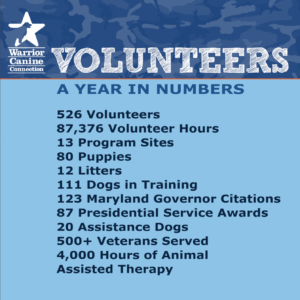
Here’s a snapshot of the impact volunteers made on WCC in 2021 (note infographic to the right).
A total of 526 volunteers assisted WCC for a record-breaking 87,376 hours donated across 13 program sites. That manpower accounts for a major cost savings to WCC, valued at $2,493,711 ($28.54 per hour) — all while helping to serve 526 Veterans through 3,997 hours of animal-assisted therapy.
So why do they do it? A few WCC volunteers share “their why” with us below.
“Volunteering with WCC means I get to be a link in the chain reaction each puppy starts from birth, with saving a veteran’s life who will then in turn change everyone else’s lives around them for the better.”
Deborah Logan, WCC Volunteer since 2020
“When I first signed up to be a WCC volunteer (as a puppy sitter) to be quite honest it was all about the love of puppies. As I learned more about the WCC programs and the incredible Veteran and military community they serve it soon turned into Fur the love of Veterans. The puppies are a wonderful and joyful bonus. Though neither myself nor my husband (who is also a volunteer) are veterans we come from a long history of them. Both of our grandfathers, fathers, uncles and my brother have all served in the US military in both the Army and Air Force. I love my volunteer jobs with WCC. It gives me a sense of community, I’ve developed many friendships with WCC employees, I’ve watched numerous litters grow up and change lives.”
Jerri Hatch, WCC Volunteer since 2016
“I’m currently Nathan’s puppy parent. I volunteer to learn how to train dogs, relieve stress, and make a helpful impact for WCC.”
John Alsterda, WCC Volunteer since 2018
“I have always been passionate about animals and know the impact that a service dog has in a person’s life. I saw it as a child. I have always had a profound respect for individuals that serve our country. Being able to volunteer in this way is a gift. Being a volunteer has taught me a lot about myself. There are no words to describe the relationship between a dog team. I see the benefits and love a dog brings to my own life and then see the greater impact one has on a veteran or veteran family.”
Krista Vega, WCC Volunteer since 2019
“I never served in the Military, although I was a Military wife. I started at WCC to honor my Dad, a Navy Veteran who passed in 2015. He wanted to volunteer with Veterans after he retired but unfortunately passed before he got the chance. It is also a way for me to serve our Military and Veterans.”
Lisa Pendleton, WCC Volunteer since 2015
“My dad is a service-disabled veteran. I grew up raising search and rescue bloodhounds with my grandfather. Becoming a WCC volunteer was the opportunity that allowed me to reconnect with what I always wanted to do as a kid: work with dogs every day, but also do that work for an amazing cause that is so important to me: supporting our veteran population. Seeing my service dog in training work with a veteran in the Mission Based Trauma Recovery program changed me forever. Seeing both the veteran and the dog benefit from the working relationship was incredible. I want to make that experience available to more veterans and raise a service dog that will change a veteran’s life.”
Bridget Forney, WCC Volunteer since 2020
“After losing our family dog in early 2021, we wanted to have a dog in our life while also giving back to our community. WCC rather serendipitously entered our lives, it’s seemed meant to be! We love knowing we are helping veterans, especially as the satellite dogs work with veterans as part of their treatment. We also love being representatives of WCC and sharing the story of the great work they do!”
Tegan Kopilenko (and sons Bennett and William), WCC Volunteer since 2021
Again, thank you to all of you, our amazing volunteers, we couldn’t do it without you!
Are you interested in volunteering for WCC? Check out our current opportunities here.
New Faces at WCC
Please join us in welcoming two new members to our team!
Kristina Frick
Kristina is the latest service dog training instructor to join our pack. She is based at the National Intrepid Center of Excellence (NICoE0) in Bethesda, where she meets with Service Members and Veterans and help run our Mission Based Trauma Recovery (MBTR) training program.
“Although I’m still settling in, I know this work is going to be absolutely rewarding and phenomenal,” said Kristina. “As a member of a military family and community, I’m excited to combine my passion for animals by providing support for Veterans.”
No stranger to the military, Kristina met and married a U.S. Army Foreign Area Officer, John, who gave her the opportunity to literally see the world. She moved 14 times in 24 years, but she was fortunate to enough earn her teaching certification in high school biology and taught off and on while stationed stateside.
Kristina graduated from Southern Illinois University with a bachelor’s in zoology. Her first job after graduation was as a zookeeper at the Houston Zoo. There, she led public animal shows with the birds of prey and educational demonstrations with Texas wildlife, exotic small mammals, nonvenomous reptiles and psittacine birds, and the general husbandry for the animals under her care.
She and her husband have two children, Isabella, 17, and Joshua, 14, and two Boasian street dogs that were rescued while their family was living in Sarajevo during one of John’s deployments.
Stacey Rogers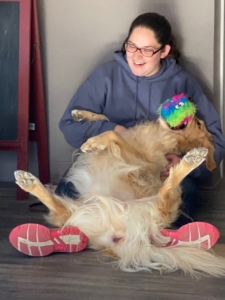
A Maryland native, Stacey joins WCC as a service dog training instructor from the Baltimore area. She started raising puppies for another organization (she is now raising her 10th puppy) and that’s what led to her interest in a career training dogs. Her experience as a puppy raiser gives her a unique perspective in her work with WCC and its amazing puppy parent volunteers.
“I completely understand what puppy parents go through when they pass the leash for advanced dog training,” said Stacey. “I was always the person bawling my eyes out before, and now I see it from the perspective of being the person taking the leash from the person crying on the other end. It’s helped me in my job to give advice and really relate to what they’re going through.”
Outside of puppy raising, Stacey worked at a dog daycare training facility in Columbia, Md., where she learned about dog behavior, body language and different play styles. Several years later, she began shadowing trainers and began leading group classes and doing 1:1 puppy training — experience that plays an instrumental role in her work teaching WCC’s “Boots” classes for puppies six months and under.
When not working, Stacey enjoys hiking with a combination of her four dogs, three of which are pets, and the puppy in training, which she is caring for until February 2023. She also enjoys participating in nose work with her Golden Retriever, Vito.
Veteran Service Organizations Team Up to Serve Warriors in the Bay Area
In 2021, as COVID-19 restrictions eased, the partnership and its programming started back up, first working in small groups outdoors at two of Swords’ locations — the Veterans Academy in Presidio and the Edwin M. Lee Apartments in Mission Bay, where the organization supports previously homeless, low-income and at-risk Veterans.
Shelley Smith is a WCC service dog training instructor who leads the MBTR training for the program. So, how does it work? Veterans involved learn to train service dogs for their fellow Veterans, facilitating a time-honored military tradition of Warriors helping Warriors. In doing so, the Veterans involved can also benefit from skills development in communication, confidence building, accountability, emotional regulation, and patience to promote an act of service while receiving a therapeutic benefit.
“It’s a win-win for both the dogs and the Veterans — the dogs are getting great practical experience with a diverse population of Veterans, many of whom may experience mobility challenges similar to those the Service Dog will later support, and the Veterans are learning new skills and also benefiting from the patience, understanding and other positives that come from working with the dogs,” said Smith.
And judging by this comment shared by a participant who asked to remain anonymous, the program is having a positive impact.
“I am always very stressed before a session, and after spending time working with the dogs, I feel 100% better and ready to accomplish my day.”
Allison Champagne, a peer support specialist for Swords to Plowshares, says out of all its program offerings, the service dog training program has become its most popular.
“I have merely been a spectator or facilitator. In my time watching these training sessions, I have seen a fairly dramatic shift in the attitude and behavior of veterans who otherwise have been known to be shy, reserved, anxious, and reclusive,” said Champagne. “After fostering a strong connection in the training process and the care of the dog, this group of Veterans has become committed, consistent, great at establishing relationships, patient, open to asking questions, vulnerable in a group setting, and confident being a leader and teacher.”
Champagne added, aside from the benefits participants gain from the program, what may be even more profound is that it also allows for the Veterans to give back to other Veterans.
Frolic with Warrior Canine Connection Dogs on National Puppy Day
What better way to celebrate National Puppy Day Wednesday than by volunteering with Warrior Canine Connection?
Warrior Canine Connection seeks puppy lovers to help raise a future service dog for present and former members of the United States military. Check out the full story on MyMCMedia.org here.
Puppy Parents Needed to Raise Service Dogs for Veterans
Warrior Canine Connection is seeking puppy lovers to help raise a future service dog for present and former members of the United States military.
“We are in dire need of puppy parent volunteers,” said Beth Bourgeois, media relations officer for the nonprofit in Boyds. The organization seeks at least a dozen puppy parents. Read the full story on MYMCMedia.org here.
Warrior Canine Connection Receives Mission-Critical Equipment Grant from Firehouse Subs Public Safety Foundation
Boyds, Md. – With the new year in full swing, Warrior Canine Connection (WCC) is now better equipped to keep the community of Boyds safe thanks to a grant from Firehouse Subs Public Safety Foundation. The $50,000 grant will be used to purchase a much-needed transportation vehicle for service dogs.
“We want to extend our gratitude to Firehouse Subs Public Safety Foundation and our local Firehouse Subs in Germantown for providing us with this grant,” said Rick Yount, founder and executive director, Warrior Canine Connection. “The transportation vehicle will be used to bring our mission-critical programming to our service dogs in training and allow our partner organizations to attend training and educational events in Boyds.”
WCC’s Mission Based Trauma Recovery (MBTR) program is unique from other service dog organizations in that the organization enlists Service Members and Veterans who are in recovery to help train the dogs for their fellow Warriors. Anchored in performing a military support mission, the participants in WCC’s MBTR program concurrently benefit from the program while serving others. Program participants receive therapeutic benefits from skills development in communication, confidence building, accountability, emotional regulation, and patience to promote an act of service.
Providing its MBTR program at locations across multiple states, the majority of WCC’s MBTR sessions require the transport of dogs. Currently, WCC can only transport two to three service dogs in training at a time due to the small vehicles owned by the organization. With 86 dogs currently in the two-year training pipeline, and an estimated 30 additional dogs joining the program in the coming months, it is essential for WCC to have the ability to transport multiple dogs at a time.
This year, WCC is seeing programming levels returning to pre-pandemic levels. In 2021, WCC provided more hours of MBTR service than ever before in its history — logging 3,897 hours of MBTR sessions to Veterans and is on track to break organizational records for service delivery again this year. Currently, it is estimated that one dog can impact as many as 60 different Veterans. However, as our organization grows and our population of dogs in training increases, the transportation capacity must also increase.
For the past 16 years, donations have been the driving force behind Firehouse Subs Public Safety Foundation® supporting first responders and public safety organizations nationwide. During the most recent grant cycle, the Foundation awarded 127 grants to public safety organizations across the country. The 127 grants totaling nearly $3 million were given to organizations in need of critical lifesaving equipment and resources.
For more information, please contact Beth Bourgeois, Warrior Canine Connection at beth.bourgeois@warriorcanineconnection.org or 719-216-3206.
To donate and learn more about Firehouse Subs Public Safety Foundation, visit FirehouseSubsFoundation.org.
# # #
About Warrior Canine Connection
Warrior Canine Connection is a pioneering organization that utilizes a Mission Based Trauma Recovery model to empower returning combat Veterans who have sustained physical and psychological wounds while in service to our country. Based on the concept of Warriors helping Warriors, WCC’s therapeutic service dog training program is designed to mitigate symptoms of post-traumatic stress disorder, traumatic brain injury, and other challenges, while giving injured combat Veterans a sense of purpose, and help in reintegrating back into their families and communities. For more information, visit www.warriorcanineconnection.org.
About Firehouse Subs Public Safety Foundation
In 2005, the Firehouse Subs founders established the 501(c)(3), non-profit Firehouse Subs Public Safety Foundation. The charity provides lifesaving equipment, prevention education, scholarships and continued education, and disaster relief for first responders and public safety organizations, as well as support for members of the military. Since inception, Firehouse Subs Public Safety Foundation has awarded more than $65 million to hometown heroes in 49 states and Puerto Rico.
Firehouse Subs Public Safety Foundation is honored to be listed as a four-star nonprofit organization, the highest designation, by Charity Navigator. Charity Navigator is the nation’s largest and most-utilized evaluator of charities. Grant allocations are made possible thanks to the overwhelming support of Firehouse Subs restaurants and generous donors. More than 70% of the funds raised for the Firehouse Subs Public Safety Foundation come from the generosity of Firehouse Subs guests and the restaurant brand. Please consider supporting a Firehouse Subs restaurant near you! To donate and learn more about Firehouse Subs Public Safety Foundation, visit FirehouseSubsFoundation.org.
Service Puppies in Training Help Army Veteran with Patience and Peace of Mind
Veteran Service Dog Team Dian Smith & Chuck: Life BC and AC
It was during her last tour of duty in the UK that she met, Mark, a DoD firefighter, the love of her life and husband of 31 years now. That was also about the time Desert Storm started. She and Mark both volunteered to travel to support U.S. military efforts, but both were held at their respective duty stations to help support staff.
In 1991, Dian felt it was time to get out and move on to something different; she left the Air Force and moved stateside. She became a veterinary technician, where she worked for a while, then she went back to bioenvironmental engineering as a DoD employee for several years.
In 1994, she and Mark had their son, Shannon Mark, who is now a DoD firefighter on the same crew her husband used to run all those years ago.
Life was moving on, but Dian wasn’t. She found herself experiencing severe anxiety and depression that prevented her from doing a lot of things. She sought help from medical experts.
“I was dealing with PTSD for many years and didn’t know it until I finally got diagnosed by the VA,” said Dian. “The diagnosis was a shock … I was floored. I had internalized a lot of things I had gone through in the military and didn’t even realize it.”
A doctor recommended she get a service dog. Not being a post 9/11 Veteran, she said she didn’t realize a service dog was an option for her. Her research yielded Warrior Canine Connection (WCC). It took a while but after applying, Dian was matched with Chuck, or rather, as she says, ‘Chuck picked her’ in February 2020.
After Chuck
“He’s been such a blessing, I can’t even begin to tell you how much he’s changed my life,” said Dian. “I wouldn’t go anywhere without a safety, which would mean a friend, so I didn’t leave my house unless I was with one of those 2-3 people, and one of them was my husband, and he’s a firefighter and he works 48 on, 48 off, and he teaches around the country, so I am alone a lot. Then I got Chuck, and I can go anywhere now. I can go to Costco … I can go anywhere, do anything because I have him. Being able to focus on him, helps me deal with my issues.”
Dian still participates in therapy and says Chuck is the perfect complement to all of them.
“Because I have Chuck, using the tools I’ve learned from my doctors, coupled together is much more effective,” said Dian. “When I’m stressed, he recognizes that and alerts me by nudging my hand with his nose. If I don’t react to that, he’ll jump up and let me know. We’re just so in-tune with each other.”
Flying? That wasn’t an option without medication before Chuck. Now, it’s a safe space with him by her side.
When he’s not working, Dian says Chuck’s a regular dog who enjoys playing with her other two pet dogs, Sawyer and Tallulah. But no matter what, Chuck’s always somewhere nearby. The two can regularly be found at church together, where the duo manages guest services and they also volunteer with another local program that helps others through equine therapy.
Dian says life is a beautiful journey and that she wouldn’t trade her earlier experiences for the world but that she’s happy to be in a good place — with Chuck right by her side every step of the way.
You can follow Chuck and Dian’s adventures together on Facebook. Next month marks Chuck’s fourth birthday, so be sure to follow along, as Dian promises there will be a celebration complete with homemade doggie cookies and plenty of birthday photos.