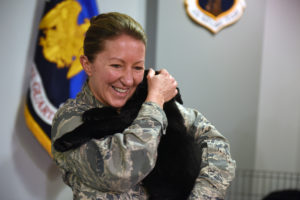
(U.S. Army National Guard photo by Sgt. 1st Class Jim Greenhill)
By Meg Daley Olmert
Despite the tens of billions of dollars being spent on Veteran health care, many Veterans continue to suffer from post-traumatic stress disorder (PTSD) and traumatic brain injuries (TBI). In a 2011 editorial in the Journal of the America Medical Association, military medical researcher, Charles Hoge M.D., summed up the efficacy of combat PTSD care, “With only 50% of Veterans seeking care and a 40% recovery rate, current strategies will effectively reach no more and 20% of all veterans needing PTSD care.”
Maj. Gary Wynn, a PTSD research psychiatrist at the Uniformed Services University of Health Sciences in Bethesda, Maryland, has called for a mandate to focus on keeping veterans in treatment by better matching therapies to patient preference.
The use of animal assisted therapy has been increasingly utilized for a variety of pain and mental health issues. Animal Assisted Therapy (AAT), especially with dogs, may be well-suited to attract and retain treatment-resistant PTSD patients and enhance outcomes from conventional treatment programs. A survey of pet ownership among military found that, despite the burden of frequent relocation and occasional quarantine periods, the U.S. military community is committed to the human-animal bond. Military families share their homes with more than 400,000 pets. A survey of 896 military families found that 98% considered their pets to be members of their family.
In 2011, Rick Yount created WCC to support and expand our unique AAT model to support the treatment of service members with traumatic combat injuries at the National Intrepid Center of Excellence (NICoE). Hundreds of NICoE patients volunteer for WCC’s Mission Based Trauma Recovery Program (MBTR), a meaningful and challenging mission of training a young service dog for a fellow Veteran in-need.
Disturbed trust is commonly encountered in cases of PTSD and, in a recent study, soldiers cited a general lack of trust in mental health professionals as their key reason for treatment drop-out.5 WCC’s program takes therapeutic advantage of the fact that even the most severely wounded Veteran can still form social bonds with dogs. WCC’s Labradors and Golden Retrievers are specially selected for a calm, sociable temperament that will make them reliable and valuable mobility service.
Anecdotal testimonies of MBTR’s effects on PTSD symptom reduction from patients, family members and caregivers received additional support from a recent five-year retroactive review (2012-2015) of MBTR at the Bethesda national military medical center. Analysis of MBTR’s trainer-reported evaluations was presented at a meeting at the National Institute of Health found that participants’ emotional, cognitive, and social competencies improved significantly between their first to their last session.
In 2014, The Uniformed Services University of Health Science Consortium for Health and Military Performance was awarded funding by the U.S. Army Medical Research and Materiel Command to conduct a randomized, (waitlist) controlled pilot study to investigate the acceptability, feasibility, and outcomes (psychological and behavioral) of participation in six one-hour MBTR sessions. Research participants were recruited from the DoD Outpatient Clinic (Psychiatry and Behavioral Health).
Over a period of three years, 29 volunteers completed this pilot study: 12 in the MBTR group and 17 in the Waitlist group.
Despite the burden of completing 2-3 hours of research requirements, program retention for MBTR was very high. Eleven of 12 SDTP participants completed all six one-hour training sessions. One person had to drop out due to a sudden health crisis.
MBTR’s stress-coping effects were reflected in cardiac measures taken during research sessions. These showed improvement in participants’ heart rate variability (HRV)—the heart’s ability to respond to and recover from stressful experiences. This key nervous system function has been shown to be dysregulated by PTSD. Participants’ HRV measures showed significant improvement within 10 minutes and at the end of the first and last MBTR sessions. Attendance and retention in WCC’s program offer encouraging support for the acceptability of the MBTR model and the feasibility of offering it as adjunctive therapy in a clinic facility. Data from PTSD symptom scores are encouraging and currently being prepared for publication in late 2019 or early 2020.
WCC’s MBTR program is also the focus of a larger, longer, more in-depth study being conducted in Bethesda and at the National Intrepid Center of Excellence (NICoE). This study, also Congressionally funded, will look at the biopsychosocial effects 12 hours of MBTR on 220 participants with follow up measures at three months for possible long-term effects.
Over the last few years, four other studies investigated the impact of training service dogs on symptoms of combat-related PTSD. These studies focused on four different not-for-profit service dog organizations across the country that operate under individual program philosophies and practices. Despite the differences in the four programs and the protocols used to investigate them, all showed a reduction in PTSD symptoms.
These are indeed exciting, long-overdue times for research into the therapeutic potential of service dog training as a safe, effective, non-pharmaceutical intervention for the reduction of PTSD. Stay tuned!








Warrior Canine Connection on LifeChangingRadio.com
August 3, 2019 – Warrior Canine Connection Founder and Executive Director Rick Yount was recently interviewed by Jon Vaught with LifeChangingRadio.com. You can listen to the interview here. (Note: The WCC segment begins at 16:20 into the recording.)
Hubert Company Hosts Fundraiser to Benefit WCC
This summer, Hubert employee and EPW Laura Hawley created a recent in-house fundraiser to benefit WCC. The event, which included a human agility course, a pet photo contest, bake sale, and other events for employees and their families, including the WCC puppy cam livestream, raised a grand total of $3,200, making it the most successful in-house fundraiser in Hubert’s history.
The company, which provides retail merchandising solutions and support products, has a long tradition and culture of supporting the community through volunteerism and fundraising campaigns. In fact, the company established a Volunteer Leadership Council (VLC) in 2002, to enlist its employees to help support different causes and nonprofits dear to its employees’ hearts.
“I’ve been aware of WCC since Holly’s Half Dozen and have always followed the organization and the great work it’s doing to help Veterans,” said Laura. “We have a great program here at Hubert to help give back to others, so I set the wheels in motion to host a fundraiser for WCC. We reached out to people who love dogs and have a connection to the military, and it was a huge hit!”
WCC would like to say a special thank you to the Hubert Company in Harrison, Ohio, and its employees who are providing critical funds to support our mission!
“Fundraisers like this one are invaluable to Warrior Canine Connection,” said Jennifer Wilder, director of development, WCC. “Many of people don’t have the expendable income to donate large amounts but community fundraising events, like this one, along with some creativity and some elbow grease can really have an incredible impact on our efforts to support wounded Veterans.”
WCC Puppies Helping to Heal A Broken Heart
“She was such a wonderful, happy person, a great mom, wife, friend and daughter,” says Peggy.
Beth went to college in Georgia, got married and had two children, Emma and Evan, and lived in the home she’d always dreamt about. She had everything in life she wanted.
But in 2015, she began having some concerning medical issues. Soon after, she was diagnosed with stage IV colon cancer. By the time it had been discovered, it was too late.
From there, Peggy, a single parent, endured an intense, year-plus journey into the world of caregiving; she retired early from her job working with special ed students so she could travel back and forth from Maryland to Atlanta to look after her daughter and help out the family. Sadly, Beth passed away in September of 2017 at the age of only 45.
“I was there when she came into the world and I was lying at her side holding her hand when she passed. She was at peace, so I’m thankful for that,” says Peggy.
When Peggy returned home to Maryland — a huge piece of her heart missing — she completely shut down with immeasurable grief. Knowing she had to do something, Peggy joined a support group for people, like her, who had had lost a child.
She also started seeing a therapist who happened to have been a volunteer at WCC. Knowing Peggy enjoyed dogs, her therapist recommended she sign up for puppy petting.
“I could not sleep at night and kept reliving the day that Beth passed and all of the traumatic memories of that day, so I got involved with whelping training and started doing overnight shifts,” said Peggy. “I wasn’t ready to be around people, and volunteering at WCC helped edge me back into the world again. Not to mention, the puppies and mamas kept me so busy, and it just really worked for me. I credit the wonderful WCC staff and dogs with giving me the support that I needed at the time.”
In fact, to-date, Peggy has logged more than 340 hours volunteering at WCC.
“I didn’t go in thinking it was about me, but it really did end up being therapeutic for me too,” says Peggy. “It gave me purpose, made me feel useful, and helped get me out of the house and, at the same time, it also gave me my space to grieve. I know they’re being trained for our Veterans, but these dogs are also helping to heal so many others along the way.”
Peggy still makes regular trips to Atlanta to see her grandchildren and son-in-law, Mike. July 18th was Beth’s birthday. And although September will undoubtedly be another tough month ahead, Peggy says one thing she is looking forward to is attending her first WCC graduation.
The Batchelor Foundation Continues Tradition of Generosity
EPW Terrie Bates holding a WCC puppy.
George E. Batchelor had many passions in life. He learned to fly at age 16 and began his long aviation career in his early 20’s by helping design the P-51 fighter plane. Mr. Batchelor served his country during World War II as a decorated Army Air Corps officer, transport and bomber pilot. He also had a deep fondness for animals and the environment, and so when he established The Batchelor Foundation Inc. those were among the key areas of which he chose to give support.
In fact, the Batchelor Foundation’s mission is to provide philanthropic support to nonprofit organizations that focus on promoting the good health, education and well-being of children, animal welfare and the preservation of the natural environment in South Florida.
And recently, the Batchelor Foundation provided a grant to Warrior Canine Connection — the fourth of its kind since 2014, to help support the WCC service dog training programs. WCC is unique from other organizations the Batchelor Foundation funds being that it’s based in Maryland.
“Although Warrior Canine Connection’s mission fell outside the range of the Batchelor Foundation’s typical giving geography, the leadership team felt there was a strong fit and unique opportunity to honor both George’s distinguished WWII military service and love of dogs by supporting WCC,” said Sandy Batchelor, Chairman and co-CEO, of the Batchelor Foundation.
Warrior Canine Connection came to the Batchelor Foundation by way of Extreme Puppy Watcher Terrie Bates, who got involved with WCC through the magic of Facebook and watching the puppy cam. She traces her ties to the organization back to “Holly’s Half Dozen,” when she and other EPWs helped pull together a party to see the puppies — that was when Explore.org, the 24-hour puppy cam, had just launched.
“My affinity for WCC started with the love of dogs, but seeing the mission in action and the difference it can make in a Veteran’s life is amazing,” said Terrie. “I grew up in the Vietnam era where it seemed like we lost an entire generation of Veterans who returned home with PTSD and other injuries, yet there was little understanding of these issues and no support system to help them. We know better today so we need to do better, and WCC is one of the organizations filling that role — helping Veterans transition and reintegrate back into their families and communities.”
A long-time employee of the South Florida Water Management District, a large government agency that services Orlando to the Keys, Terrie got to know Sandy Batchelor when Sandy served as a member of the organization’s Governing Board during her six-and-a-half-year tenure.
Each year, the South Florida Water Management District picks a charity to benefit from their employee’s fundraising activities; in 2014, WCC was selected based on Terrie’s nomination. Sandy volunteered to be the Honorary Event Chairwoman on behalf of the Governing Board and several years later, the Batchelor Foundation is still providing generous support to Warrior Canine Connection and Terrie is still glued to the WCC puppy cam.
“I think it’s always understated how much everybody that’s associated with WCC gets out of their affiliation,” says Terrie. “There are so many friendships that have been made across the country among people who literally would have never met otherwise. They all feel like they’re contributing — certainly, the mission and focus is on Veterans, but the support and connections touch a lot more lives than just the Veterans — an entire community has come together as a result.”
New Faces at WCC
Emily Fritz comes to WCC after spending four years working in the nonprofit service dog industry, where she got her start as an intern and worked her way up, learning everything she could; she worked in the kennels, development, outreach and as the graduate support coordinator.
Emily has jumped in quickly at WCC and says the experience has already had a profound impact on her.
“I feel like I’ve learned so much in the past month,” says Emily. “It’s incredible being part of such a unique community and family and getting to see that “magic” of when a Veteran connects with their dog and seeing how it affects them by giving them mobility, freedom and companionship. It’s already been such a wonderful experience — I’ve met a lot of amazing people already in the short time I’ve been here.”
When not working at WCC, Emily can be found 99% of the time alongside her own trusty black Lab, “Cheeky.”
“(Says laughing) I love answering the question of what I do outside of work because my life just revolves around dogs,” says Emily. “I look at her and ask what she wants to do and that’s what we do. From swim training and nose work to hanging on the beach, I love spending my time doing anything my dog’s interested in.”
Emily graduated from the University of Delaware with a bachelor’s in animal science and a minor in disability studies. She is currently working on her master’s in human-canine life sciences at Bergin University.
Recently engaged to fiancé, John, Emily is also busy planning her wedding.
Emily McNeal comes to WCC from the U.S. Army, where she spent five years working as a lab tech. She spent most of her time in the service at Walter Reed. That’s where she began volunteering with facility dogs and began pursuing her passion to work with service dogs.
“When I was at the hospital in the Army, we would take the facility dogs to visit patients and seeing how they reacted at seeing the dogs really sparked my interest in working more closely with them,” says Emily. “It was amazing to see how, in such a short amount of time, the dogs would take their focus elsewhere — away from the pain they were dealing with — and brighten their day. Even if only for a few minutes, it was amazing to see.”
Now she’s excited to pair that prior experience with her passion for working with service dogs to help Veterans.
“I am so excited to be part of the WCC team,” says Emily. “It’s amazing to see these big, strong Veterans who have been through some life-changing experiences that some of us can’t even imagine – smile and open up while holding a tiny puppy in their arms, it’s so encouraging to see.”
Prior to joining the Army, Emily earned her undergraduate degree in childhood psychology and a master’s in human services, health and wellness, both from Liberty University.
When not spending time at WCC, Emily can usually be found coaching others as a Level 1 CrossFit Trainer at a local gym in Maryland.
Please join us in welcoming both Emily F. and Emily M. to our team!
The Labrador pups and the World War II Vets
July 14, 2019 – Ready for some happy, straightforward news for a change? A new litter of Labrador retriever puppies — destined to be trained as highly specialized service dogs by the nonprofit Warrior Canine Connection — will soon have a special designation of their own. The six new arrivals are to be named after American heroes who served on D-Day in “Operation Overlord.” Read the complete story in The Washington Times here.
Protect Your Pet from the Heat During the Dog Days of Summer
Remember, dogs aren’t as efficient at cooling their body temperatures as we are — they’re built to conserve rather than release heat and tend to heat up much more quickly than we do.
Here are some simple dos and don’ts to keep your best friend safe and comfortable during the summer months.
Dos
1. Always provide access to cold, fresh water.
2. Create a splash pool or find a local watering hole that allows dogs to cool off in the water. For dogs who enjoy the water, simply laying in it can help bring body temperatures down.
3. Limit your dog’s exercise when temperatures rise. Consider shorter walks in the morning and in the evenings when the temperatures have dropped.
4. Protect your dog’s paws by limiting walks to grassy areas and other cooler surfaces or wait to take a stroll until the sun goes down.
5. Make sure you know how to recognize the signs of overheating in your dog. They include excessive panting or difficulty breathing, increased heart rate, staggering, seizures and loss of consciousness.
Don’ts
1. Never, ever leave your dog in the car unattended. Even if the car is parked in the shade or it’s “only for a few minutes,” the temperature inside of a car can reach oven-like temperatures in just minutes. It’s also illegal; to-date, 31 U.S. states have laws prohibiting leaving an animal in a confined vehicle under dangerous conditions.
2. Keep your dog away from surfaces that get hot from the sun, like asphalt and cement. Being near the ground can heat their body quickly and lead to paw and skin burns.
3. If you suspect your dog is overheated, don’t try to force him to drink or submerge him in cold water— it’s best to seek immediate veterinary attention.
Maryland Public Television’s Salute to Veterans: Warrior Canine Connection
June 28, 2019 — Maryland Public Television recently featured Warrior Canine Connection in its “Salute To Veterans” segment to showcase how dogs are being bred and raised for a unique purpose — to help veterans with PTSD or mobility issues. MPT’s Nancy Yamada recently visited WCC’s Healing Quarters in Boyds, watch the story here.
Is Your Dog Ready for Fireworks?
Did you know that more dogs run away on the Fourth of July than any other day of the year? That’s why it’s crucial to take precautions in advance of the holiday. Here are a few simple steps you can take to ensure your dog’s safety.
Did we mention that preparation is a crucial element to ensure the safety and comfort of your dog prior to his first fireworks experience?If you can’t be with your dog during the fireworks, we recommend placing him with a friend or family member who can keep him company during the show to soothe him during the loud pops, bangs and bursts.If it’s an unfamiliar place for your dog, we recommend taking him there several times in advance so it’s a familiar and comfortable setting.
If you can’t take your dog somewhere and you aren’t going to be home, we recommend placing him in a crate with the radio playing. Be sure to include a treat, like a frozen Kong to keep him busy. We do require supervision for our service dogs in training ages six months and younger, and we highly recommend it for any all pets who will be experiencing their first fireworks display.
During our service dog training, we routinely expose our dogs to different sights and sounds. Although fireworks are louder and brighter, we do practice playing loud sounds for our dogs to help acclimate them to the noise. If possible, we recommend playing recorded sounds of fireworks in the months in the lead-up to the Fourth of July to help condition your dog.
If you are going to be with your dog during the fireworks, continue to talk to him, and send him reassuring messages that there’s nothing to worry about. As we like to say, “throw a party” if you notice your dog doesn’t react to the initial loud noises. Don’t be afraid to pull out those tasty bones, treats and toys to make the time special and fun for him.Remember, just a few steps on your part can ensure that both you and your dog can enjoy a very happy Fourth of July.
Why Dogs Work: The Science of the Warrior Canine Connection
(U.S. Army National Guard photo by Sgt. 1st Class Jim Greenhill)
By Meg Daley Olmert
Despite the tens of billions of dollars being spent on Veteran health care, many Veterans continue to suffer from post-traumatic stress disorder (PTSD) and traumatic brain injuries (TBI). In a 2011 editorial in the Journal of the America Medical Association, military medical researcher, Charles Hoge M.D., summed up the efficacy of combat PTSD care, “With only 50% of Veterans seeking care and a 40% recovery rate, current strategies will effectively reach no more and 20% of all veterans needing PTSD care.”
Maj. Gary Wynn, a PTSD research psychiatrist at the Uniformed Services University of Health Sciences in Bethesda, Maryland, has called for a mandate to focus on keeping veterans in treatment by better matching therapies to patient preference.
The use of animal assisted therapy has been increasingly utilized for a variety of pain and mental health issues. Animal Assisted Therapy (AAT), especially with dogs, may be well-suited to attract and retain treatment-resistant PTSD patients and enhance outcomes from conventional treatment programs. A survey of pet ownership among military found that, despite the burden of frequent relocation and occasional quarantine periods, the U.S. military community is committed to the human-animal bond. Military families share their homes with more than 400,000 pets. A survey of 896 military families found that 98% considered their pets to be members of their family.
In 2011, Rick Yount created WCC to support and expand our unique AAT model to support the treatment of service members with traumatic combat injuries at the National Intrepid Center of Excellence (NICoE). Hundreds of NICoE patients volunteer for WCC’s Mission Based Trauma Recovery Program (MBTR), a meaningful and challenging mission of training a young service dog for a fellow Veteran in-need.
Disturbed trust is commonly encountered in cases of PTSD and, in a recent study, soldiers cited a general lack of trust in mental health professionals as their key reason for treatment drop-out.5 WCC’s program takes therapeutic advantage of the fact that even the most severely wounded Veteran can still form social bonds with dogs. WCC’s Labradors and Golden Retrievers are specially selected for a calm, sociable temperament that will make them reliable and valuable mobility service.
Anecdotal testimonies of MBTR’s effects on PTSD symptom reduction from patients, family members and caregivers received additional support from a recent five-year retroactive review (2012-2015) of MBTR at the Bethesda national military medical center. Analysis of MBTR’s trainer-reported evaluations was presented at a meeting at the National Institute of Health found that participants’ emotional, cognitive, and social competencies improved significantly between their first to their last session.
In 2014, The Uniformed Services University of Health Science Consortium for Health and Military Performance was awarded funding by the U.S. Army Medical Research and Materiel Command to conduct a randomized, (waitlist) controlled pilot study to investigate the acceptability, feasibility, and outcomes (psychological and behavioral) of participation in six one-hour MBTR sessions. Research participants were recruited from the DoD Outpatient Clinic (Psychiatry and Behavioral Health).
Over a period of three years, 29 volunteers completed this pilot study: 12 in the MBTR group and 17 in the Waitlist group.
Despite the burden of completing 2-3 hours of research requirements, program retention for MBTR was very high. Eleven of 12 SDTP participants completed all six one-hour training sessions. One person had to drop out due to a sudden health crisis.
MBTR’s stress-coping effects were reflected in cardiac measures taken during research sessions. These showed improvement in participants’ heart rate variability (HRV)—the heart’s ability to respond to and recover from stressful experiences. This key nervous system function has been shown to be dysregulated by PTSD. Participants’ HRV measures showed significant improvement within 10 minutes and at the end of the first and last MBTR sessions. Attendance and retention in WCC’s program offer encouraging support for the acceptability of the MBTR model and the feasibility of offering it as adjunctive therapy in a clinic facility. Data from PTSD symptom scores are encouraging and currently being prepared for publication in late 2019 or early 2020.
WCC’s MBTR program is also the focus of a larger, longer, more in-depth study being conducted in Bethesda and at the National Intrepid Center of Excellence (NICoE). This study, also Congressionally funded, will look at the biopsychosocial effects 12 hours of MBTR on 220 participants with follow up measures at three months for possible long-term effects.
Over the last few years, four other studies investigated the impact of training service dogs on symptoms of combat-related PTSD. These studies focused on four different not-for-profit service dog organizations across the country that operate under individual program philosophies and practices. Despite the differences in the four programs and the protocols used to investigate them, all showed a reduction in PTSD symptoms.
These are indeed exciting, long-overdue times for research into the therapeutic potential of service dog training as a safe, effective, non-pharmaceutical intervention for the reduction of PTSD. Stay tuned!