 What do developing autonomous vehicles and training service dogs have in common? More than you might think! Before we dive into this unlikely comparison, let’s provide some context.
Enter John Alsterda, Systems Engineer at Waymo LLC, Ph.D. candidate at Stanford University, U.S. Navy Reservist, and Warrior Canine Connection (WCC) volunteer. John develops autonomous driving technology in his professional capacities, and is Puppy Parent to service dog in training, Nathan.
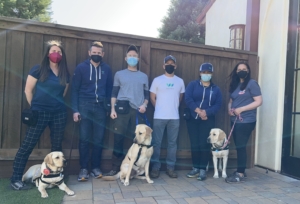
John’s work at Waymo allowed him to combine both interests, as he and fellow Veterans at the company recently gathered to host a community clean-up day – WCC’s Nathan and other WCC service dogs in training participated. The Veterans at Waymo employee resource group supports and builds community among veterans working at Waymo, including with volunteer opportunities like this one.
“There’s something about how dogs give you their undivided attention and love that is so powerful,” said John. “During my day, so many things pull on my attention and I feel like I’m always multitasking. But Nathan treats me like I’m the only other person in the world—I feel like no other animal or person has that capacity.”
John studied physics at University of Illinois for undergrad, after which he commissioned into the U.S. Navy. He spent four years at the Naval Nuclear Power School, teaching the principles of nuclear power plant operation on submarines and aircraft carriers to Navy sailors. Next, John transitioned to the Navy Reserve to pursue his Ph.D. at Stanford.
It was there he learned about Stanford’s partnership with WCC and got involved in its Mission Based Trauma Recovery (MBTR) program for Veterans. Essentially, those involved help train service dogs for their fellow Service Members and Veterans, which fulfills a time-honored military tradition of Warriors helping Warriors. In doing so, the Veteran can also benefit from social and emotional skill development, improved communication, confidence building, reduced isolation, improved emotional regulation, and reduced stress, which many of the Stanford student Veterans greatly benefit from.
From September 2019 through July 2021, John volunteered in a total of 53 MBTR sessions while working on his doctorate. Not only that, he and his wife, Ashley Fabrizio, also helped with puppy sitting needs, followed by becoming Puppy Parents to WCC’s Nathan, who recently graduated to advanced training at WCC’s Healing Quarters in Boyds, Maryland.
Onto comparing autonomously driven vehicles and service dogs: As John can tell you, the fundamentals involve training the dogs to do the things we want them to do through rewards, like attention and treats. They don’t receive rewards for behaviors we don’t want, and they quickly learn to optimize for these incentives.
“That is fundamentally similar to the way autonomous vehicles can be encouraged to do what we want them to,” said John. “We don’t need to give them treats; they’re even easier to please! By defining a mathematical reward function, we can assign points to behaviors we want or don’t want – positive rewards for good things like staying in-lane, and negative rewards (penalties) for things to avoid like lingering too long on a crosswalk. The algorithm solves this math problem over and over again to figure out how to get the most rewards and avoid the most penalties.”
This is where things get complicated … John added, “because we need to describe complex things both to our dogs and our autonomous driver, not just put your paw on the ground or stay between the lane lines. Dogs don’t understand math, but they can be taught some human language and they understand feelings like good, bad, happy, or lonely. Our cars are better at math, but it’s challenging to describe all the things they need to know with hand-tuned rewards. These less tangible things can be encoded with neural networks, which are a mathematical way to describe things like other drivers’ behavior or how to recognize street signs.”
John explains, “Nathan’s learning process may be similar to training a neural network. We can’t describe to him exactly what behaviors we want. We use commands; he kind of speaks our language that way, but we can’t use full sentences to say precisely what it means to heel or sit close to his handler. Rather, we teach Nathan complex tasks slowly and iteratively, adding one component or adjustment at a time until he learns the whole sequence. I feel like there’s a real similarity there, for things that are impossible to explicitly communicate to both Nathan and a car.”
Simply put, for service dogs and autonomous drivers, it pays to make the right decisions! We get more of the behaviors we reward with both cars and dogs. It’s pretty remarkable to realize how certain aspects of learning theory are not only similar across species, but even in the development of artificial intelligence. That said, an autonomous driver is never going to be as good at snuggling as your dog.








Teach kids about service dogs with WCC’s educational toolkit
Whether it’s for your own information, to share with a classroom, community group or otherwise, we invite you to check out our toolkit resources designed to educate our youth about the important work WCC does, learn more about service dogs, and inspire them to support WCC in its life-changing mission.
The toolkit resources are geared toward students in kindergarten through 12th grade, and the materials can be used in classroom settings, for scouting badges, or with school-aged church and service groups.
As an accredited Service Dog Organization, WCC has its own breeding program—whelping approximately 10-12 litters of Golden and Labrador Retrievers each year at its national headquarters in Maryland. Purpose bred for health, temperament and longevity, WCC researches many generations of each dog’s pedigree to ensure their genetic potential to become a successful Service Dog.
You’ll find a pdf with video, puppy cam links, printable handouts, trading cards featuring WCC dogs, bookmarks, fundraising ideas, and more! Learn more and download the full WCC toolkit here.
Summer Paw Protection for Pets
When it’s hot outside, the pavement heats up quickly and its temperature usually exceeds the air temperature, which can mean harsh conditions for your pet’s paw pads. Knowing when it’s too hot is crucial to prevent burns for your pet.
Air vs. Pavement Temperature
The American Kennel Club (AKC) published this helpful guide to illustrate the difference in temperatures between the air and pavement.
As you can see, when the thermometer hits 85 degrees and stays elevated throughout the day, taking your dog everywhere you go or even for a short outing can lead to a serious injury.
“Pavement, like asphalt or artificial grass, can become incredibly hot and cause discomfort, blisters, and burn a dog’s paw pads,” says Jerry Klein, DVM, AKC’s Chief Veterinary Officer and an expert in veterinary emergency and critical care.
Here are some simple tips to keep your dog happy and his paw pads healthy.
Time your walks
Choose early mornings or later evenings after the sun has set to walk your dog. The air temperature and ground surfaces will both be much cooler. Also, consider taking a grassy or shady path.
Check the pavement before your walk.
Place your hand or bare foot on the pavement for five seconds. If it’s too hot for your skin, then it’s most likely too hot for your pet.
Paw Protection Products
There are many products available on the market, like all-terrain boots for dogs, which offer protection from hot surfaces. But there is a learning curve and adjustment period for many dogs to get used to wearing them.
Many veterinarians also recommend moisturizing products which can be applied to your dog’s paw pads, which can help prevent cracking from the heat. When paw pads are dry, they’re more susceptible to burns from hot surfaces. Be sure to choose a pet-friendly and veterinarian-approved product.
Regular Paw Check
One good habit to get into is to regularly check your dog’s paws since they may not always let you know that there’s an issue. Routinely making sure paw pads and healthy can go a long way from preventing future injury.
In case of injury
In the event your dog does burn his paw pads, veterinarians recommend bringing your dog inside right away to a dry, cool place—carry him if necessary. Flush the foot with cold water or use a cool compress, and refrain from letting him lick the injured area. And of course, consult with your veterinarian.
Canines and Autonomous Vehicles Know: It Pays to Behave!
Enter John Alsterda, Systems Engineer at Waymo LLC, Ph.D. candidate at Stanford University, U.S. Navy Reservist, and Warrior Canine Connection (WCC) volunteer. John develops autonomous driving technology in his professional capacities, and is Puppy Parent to service dog in training, Nathan.
John’s work at Waymo allowed him to combine both interests, as he and fellow Veterans at the company recently gathered to host a community clean-up day – WCC’s Nathan and other WCC service dogs in training participated. The Veterans at Waymo employee resource group supports and builds community among veterans working at Waymo, including with volunteer opportunities like this one.
“There’s something about how dogs give you their undivided attention and love that is so powerful,” said John. “During my day, so many things pull on my attention and I feel like I’m always multitasking. But Nathan treats me like I’m the only other person in the world—I feel like no other animal or person has that capacity.”
John studied physics at University of Illinois for undergrad, after which he commissioned into the U.S. Navy. He spent four years at the Naval Nuclear Power School, teaching the principles of nuclear power plant operation on submarines and aircraft carriers to Navy sailors. Next, John transitioned to the Navy Reserve to pursue his Ph.D. at Stanford.
It was there he learned about Stanford’s partnership with WCC and got involved in its Mission Based Trauma Recovery (MBTR) program for Veterans. Essentially, those involved help train service dogs for their fellow Service Members and Veterans, which fulfills a time-honored military tradition of Warriors helping Warriors. In doing so, the Veteran can also benefit from social and emotional skill development, improved communication, confidence building, reduced isolation, improved emotional regulation, and reduced stress, which many of the Stanford student Veterans greatly benefit from.
From September 2019 through July 2021, John volunteered in a total of 53 MBTR sessions while working on his doctorate. Not only that, he and his wife, Ashley Fabrizio, also helped with puppy sitting needs, followed by becoming Puppy Parents to WCC’s Nathan, who recently graduated to advanced training at WCC’s Healing Quarters in Boyds, Maryland.
Onto comparing autonomously driven vehicles and service dogs: As John can tell you, the fundamentals involve training the dogs to do the things we want them to do through rewards, like attention and treats. They don’t receive rewards for behaviors we don’t want, and they quickly learn to optimize for these incentives.
“That is fundamentally similar to the way autonomous vehicles can be encouraged to do what we want them to,” said John. “We don’t need to give them treats; they’re even easier to please! By defining a mathematical reward function, we can assign points to behaviors we want or don’t want – positive rewards for good things like staying in-lane, and negative rewards (penalties) for things to avoid like lingering too long on a crosswalk. The algorithm solves this math problem over and over again to figure out how to get the most rewards and avoid the most penalties.”
This is where things get complicated … John added, “because we need to describe complex things both to our dogs and our autonomous driver, not just put your paw on the ground or stay between the lane lines. Dogs don’t understand math, but they can be taught some human language and they understand feelings like good, bad, happy, or lonely. Our cars are better at math, but it’s challenging to describe all the things they need to know with hand-tuned rewards. These less tangible things can be encoded with neural networks, which are a mathematical way to describe things like other drivers’ behavior or how to recognize street signs.”
John explains, “Nathan’s learning process may be similar to training a neural network. We can’t describe to him exactly what behaviors we want. We use commands; he kind of speaks our language that way, but we can’t use full sentences to say precisely what it means to heel or sit close to his handler. Rather, we teach Nathan complex tasks slowly and iteratively, adding one component or adjustment at a time until he learns the whole sequence. I feel like there’s a real similarity there, for things that are impossible to explicitly communicate to both Nathan and a car.”
Simply put, for service dogs and autonomous drivers, it pays to make the right decisions! We get more of the behaviors we reward with both cars and dogs. It’s pretty remarkable to realize how certain aspects of learning theory are not only similar across species, but even in the development of artificial intelligence. That said, an autonomous driver is never going to be as good at snuggling as your dog.
Asheville veterans helping turn dogs into service animals
ASHEVILLE, N.C. — A group of volunteer veterans are using their time to help other veterans by raising dogs to be service animals for them.
The Asheville branch of Warrior Canine Connection trains about four to five dogs at a time and has been in operation for four years. Read and watch the full story from Spectrum News 1 here.
Canine Connection
Training service dogs helps veterans heal
July 6, 2022 – Asheville can feel as if dogs have the run of the place. They are seemingly in every brewery and every restaurant and every trail. Nearly all of these animals are pets that might occasionally earn their keep by barking at a black bear in the trash or chasing a gopher from the tomato patch. Read the full story in Mountain Xpress here (story begins on page 20).
Recognizing National PTSD Awareness Day with Warrior Canine Connection
June 27, 2022 – Warrior Canine Connection Founder Rick Yount joins FOX 5 to share the importance of animal therapy when dealing with PTSD. Watch the news story here.
2022 WCC T-Shirt Artwork Design Contest
Be a part of Warrior Canine Connection’s graduation history by designing a limited edition t-shirt celebrating the Virtual Graduation Class of 2022! The contest is open to everyone of all ages and the winning designer will receive a FREE t-shirt featuring their artwork and bragging rights.
GUIDELINES
· Design should not exceed three ink colors
· Design for back of t-shirt only
· If submitting a hand drawing, please submit no larger than 8.5 x 11-inch size
· Multiple designs may be submitted
SUBMISSION DEADLINE: JULY 15, 2022
Design submissions can be emailed as an attachment to info@warriorcanineconnection.org. Hand-drawn submissions are accepted and can be scanned in and submitted as an email attachment.
Acceptable submission formats include *.jpg, *.png, *.ai, *.eps. If designed in Illustrator, Photoshop, or other software, we will request original artwork file if selected.
Once the submission date has closed, WCC will select the winning design and announce it on our Facebook page. We also look forward to sharing a gallery of everyone’s submissions this summer.
FINE PRINT
By submitting a design, the designer consents that his/her design is their own original artwork and that he/she has all the necessary rights and permissions to use included elements. Please do not use elements or designs created by someone else. Images that are not submitted in vector format will need to be recreated. Warrior Canine Connection reserves the right to make adjustments and alterations to the winning entry to ensure that the reproduction of the image is the best quality. The winning designer releases all exclusive rights to the artwork to be used for Virtual Graduation 2022 material. The winner will be rewarded with a WCC graduation t-shirt featuring his/her design.
Dogs Who Serve
June 6, 2022 – Service dogs can help veterans with Post Traumatic Stress Disorder by providing calming support with everyday tasks. A law signed in August 2021 allowed the Department of Veteran Affairs to launch a new program in which veterans with PTSD help train service dogs for other veterans. We speak with Rick Yount, the Executive Director of Warrior Canine Connection, a nonprofit that teaches veterans how to train service dogs for other veterans, about how involving veterans in dog training can help them heal.
Listen to the “Dogs Who Serve” podcast on The Takeaway here.
WCC Report Card: Healthy Eyes & Hearts
Special thanks to ophthalmologist Dr. Nancy Bromberg, VCA Southpaws Veterinary Specialists, and cardiologist Dr. Neal Peckens, Chesapeake Veterinary Cardiology Associates (CVCA), who both lent their time and talents to ensure the health, livelihood, and longevity of these service dogs in training who will go on to help many Service Members and Veterans. Partner, Susquehanna Service Dogs (SSD), also brought some of the dogs from its program to be screened.
“Our goal is to have dilated ophthalmologic exams done all dogs in training, breeding dogs and retired breeding dogs annually,” said Molly Morelli, director of Dog Programs, WCC. “Although we do genotype testing on all our breeding dogs, there are other eye issues that can show up at any time during a dog’s lifetime.”
The number of echocardiograms was much lower, as they are performed on only those dogs that are considered breeder potentials. A disease called Tricuspid Valve Dysplasia does not often cause a murmur, and the only way to screen for this is via an echo done by a board-certified cardiologist.
Offered twice a year, the next WCC Eye & Heart Day is scheduled for November 12.
June Marks Post-Traumatic Stress Disorder Awareness Month
This month and every month, WCC is committing to help fight the stigma around PTSD, providing support to and advocating for Service Members and Veterans who are battling PTSD. In fact, WCC is proud to have been chosen to staff two of the five sites for the Puppies Assisting Wounded Service Members and Veterans Therapy Act (PAWS Act) pilot program being provided under the auspices of the Department of Veterans Affairs. This program will provide canine training to eligible Veterans who have been diagnosed with PTSD as a complementary and integrative health program.
One Veteran who participated in WCC’s Mission Based Trauma Recovery (MBTR) program anonymously shared, “My mindset was pretty combative, and I brought the war home with me when I returned from my first and second deployment in 2010 and 2012. When I tried to get a job, go to college, I struggled. When I started with Warrior Canine Connection, I didn’t know how to pretend to be happy. No amount of social discomfort was going to stop me from learning how to up my pitch a little bit to help these dogs out because these really are amazing animals and anything I give in to helping them, I feel I get back tenfold. I like to say I’m volunteering but what I don’t tell people is that the dogs are really helping me. The benefits of working with the dogs have helped me feel that I’m becoming a functional member of our society and the satisfaction that I get from that is hard to quantify.”
It’s important to note that training service dogs or having one isn’t a magic pill to combat PTSD—it takes a lot of hard work, time, and commitment. And it’s one of many effective, integrative treatments endorsed by the medical community to support Veterans battling PTSD. The key is to know that help is available, find the options that work best for you, and know that you are not alone.
If you or someone you know need is interested in WCC’s MBTR training, you can learn more here. And if you’re unsure where to turn first, please know the Veterans Crisis Line (1-800-273-8255) is available 24/7.